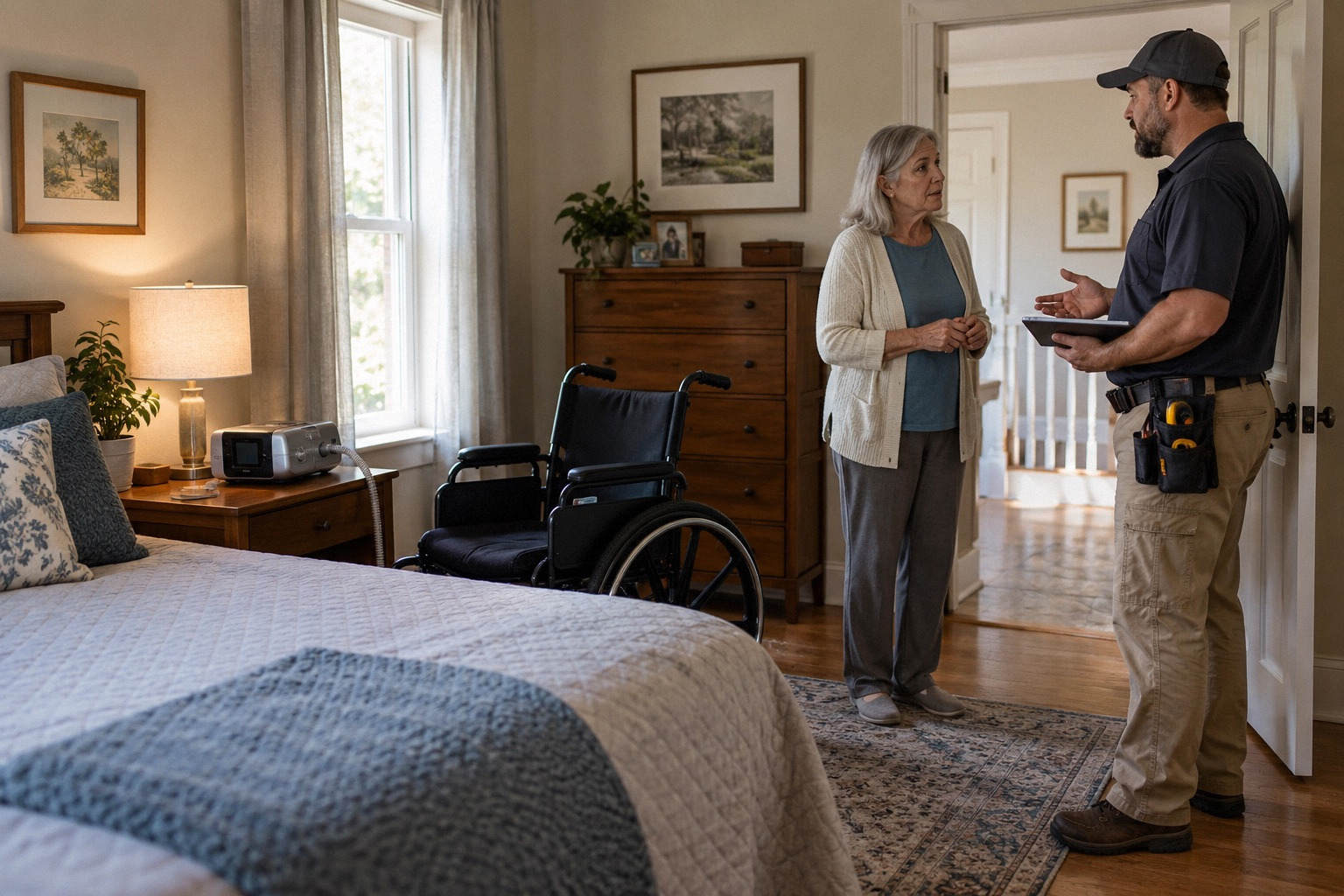
Begin with the resident's normal day
Ask the resident which rooms, devices and routes are essential and which changes would be difficult. A plan developed without that input may overlook a charging location, a transfer space or a bathroom route. Record the practical requirements in ordinary language. Avoid reducing accessibility to a single doorway width or assuming that every person using similar equipment has the same needs.
Consider both planned outages and changes in the work area. A device can have adequate power while the resident cannot reach it, or a clear route can become unusable when materials are stored overnight. Walk through the proposed construction sequence with the resident and project contact before the crew mobilizes. If privacy is important, share only the information needed to plan the work safely and effectively.
Obtain a device-specific power plan
CDC preparedness guidance recognizes that power interruptions can be serious for people using home medical equipment and recommends planning suitable alternatives. Power Sources The resident's care team and equipment supplier should establish what interruption is tolerable and what backup or relocation arrangement is appropriate. A contractor can explain the electrical work schedule but should not be expected to make medical decisions.
Keep the relevant equipment instructions and support contacts available. Ask about charging time, compatibility and the practical limits of any proposed backup. Do not infer runtime from a product advertisement or assume that a device operates normally with every portable supply. If an essential plan cannot be confirmed, arrange the work around a suitable alternative location rather than accepting an uncertain interruption.
Map access through each construction phase
Identify the route from the resident's usable room to the bathroom, exit, transportation and needed equipment. Include space for mobility devices and assistance. Keep storage and work access from consuming that route. If a required path crosses an active work zone, the plan needs a different sequence or occupancy arrangement.
For covered lead renovation, EPA's work-area guidance makes containment a defined boundary. What is the work area? A mobility need does not make it appropriate to move or bypass that boundary without the responsible renovator's review. Instead, identify an accessible alternative before containment is established. The same issue can recur during plaster and paint work, so carry the access plan through restoration rather than ending it with the electrician's installation phase.
Assign communication and decision authority
Name the person who receives outage warnings and the person who can act if the schedule changes. The resident may handle those decisions directly or designate another person. Record the preferred communication method and the notice needed to arrange transportation or assistance. A message sent only to an owner who is away at work may not reach the person affected in time.
California's CSLB contract guidance supports clearly describing work and responsibilities. What is a Contract? For this project, attach the agreed access and notification requirements to the scope. Avoid including unnecessary medical details. The contractor needs to know the operational constraint and the action required, not the resident's full health history.
Hypothetical preconstruction meeting
Imagine a resident uses a powered mobility device and equipment that must remain available overnight. The planned rewire affects the usual charging area and the hall to the bathroom. The resident, household representative and contractor review the route and schedule. The care and equipment professionals separately confirm the power contingency. If either access or equipment continuity cannot be maintained, the household arranges another location for that phase.
The meeting record should cover:
- Resident requirements: essential functions and paths, described with the resident's agreement.
- Technical forecast: expected outage areas and any uncertainty still requiring assessment.
- Equipment plan: the responsible professional contacts and the confirmed interruption arrangement.
- Accessible route: the usable path for each phase, including end-of-day material storage limits.
- Notification: who receives changes, through which channel and how urgent messages are acknowledged.
- Relocation trigger: the specific condition that means the resident moves to the prepared alternative.
- Return condition: the confirmation needed before the resident resumes the usual room and equipment arrangement.
This is a hypothetical coordination example. It does not establish medical suitability, prescribe equipment or certify a building's accessibility.
Test the plan through a realistic scenario
Before work begins, walk through what happens if the outage extends into the evening or a work zone expands unexpectedly. Who calls the resident? Who can provide transport? Where are instructions and essential supplies? A plan that depends on an unavailable person or a locked storage room needs revision. Do this as a calm planning exercise, not during the interruption itself.
Recheck the arrangement whenever the construction phase changes. The resident should be able to report that a supposedly usable route is not workable without having to prove a technical violation. The purpose is a practical, individualized project plan. When the house cannot support that plan during a phase, temporary relocation is a construction decision to organize, not a failure by the resident to tolerate inconvenience.
Your project checklist
Questions that come up next
Can the electrician choose the medical backup equipment?
The contractor can explain electrical work conditions, but the care team and equipment provider should establish the device-specific medical and compatibility plan.
Is power continuity the only issue?
No. Access to rooms, equipment, exits and assistance can be equally important during each work phase.
Sources and further reading
Questions from homeowners
These discussions helped identify the problem. Reddit experiences are anecdotal; technical and legal statements rely on the sources above.