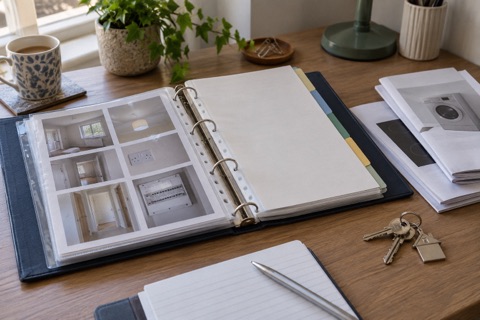
Bring the current agreement to the walk-through
Use the final room schedule and approved changes, not an early estimate that no longer describes the project. List the promised fixtures, locations, restoration level and documents. If an owner-supplied item was delayed or removed from scope, note the agreed treatment. This prevents a final conversation from becoming a debate about which version of the plan everyone remembers.
California's CSLB contract guidance supports documenting work, cleanup and warranties. What is a Contract? Translate those promises into things the owner can reasonably review. For example, a named fixture can be present or missing, a paint task can be incomplete and a promised record can be undelivered. Technical adequacy still requires the responsible qualified professionals and the applicable inspection process.
Walk each room in a consistent order
Start at the entry and follow the same route through the house. Compare visible locations and selections with the agreed schedule. Ask the electrician to demonstrate controls or explain anything unfamiliar. Record concerns without removing covers or probing equipment. A homeowner can report that a switch does not produce the expected result; the electrician should determine the cause and appropriate correction.
Include spaces easily missed during a final meeting, such as a hall, storage area, exterior location or detached structure if it was in scope. Also identify intentionally retained work so the owner does not mistake an exclusion for an omission. Keep the room list factual and tied to the agreement rather than adding every new idea that arises during the tour.
Review surfaces and protection separately
Look at the restoration promised for openings, trim, walls and ceilings. Distinguish rough closure from a finished painted surface. Compare protected features with the agreed condition record. National Park Service guidance supports deliberate treatment of important historic interiors. Preservation Brief 18: Rehabilitating Interiors in Historic Buildings If your project involved those features, include the relevant specialist or reference photographs in the review.
A visible mismatch may be a legitimate contracted correction, an expected limitation or an opportunity for broader optional refinishing. Record the observation first, then resolve it against the scope. Avoid making the electrician responsible for a separate trade's work unless the agreement assigns that responsibility. Conversely, do not let a subcontract arrangement erase a restoration promise made by the contracting company.
Verify documents rather than accepting general assurances
Ask for the final inspection result and official permit status. Portland's electrical process, for example, distinguishes final inspection from earlier stages and uses it to close the permit. Residential Electrical Permits Your local record may use a different form or label. Save the actual evidence rather than writing passed in the checklist based only on a verbal statement.
Review the circuit information, relevant product documents and warranty contacts included in the agreement. Ask who handles a later concern and how the owner should describe it. Keep any remaining document delivery on the punch list with a responsible person and date. A paid invoice may be part of the file, but it does not replace the permit result or the promised product information.
Hypothetical punch-list entries
Imagine the agreed dining-room fixture is installed, one hallway control does not behave as discussed, a bedroom patch is not at the promised finish level and the final permit record has not yet been delivered. These are different types of issues. One may need electrical diagnosis, one finish work and one administrative follow-up. Separate entries make resolution easier.
Write each item with:
- Location: a recognizable room and feature, not a vague statement such as upstairs problem.
- Observation: what the owner can see or experience, without claiming an unverified technical cause.
- Agreement reference: the schedule, selection or change that explains the expected result.
- Responsible party: the company or project contact assigned to coordinate the response.
- Proposed resolution: assessment, correction, document delivery or clarification of an exclusion.
- Access and timing: when the return visit can occur and what the household must prepare.
- Closure evidence: how both sides will confirm that the specific item has been addressed.
This is a hypothetical format, not a statement that every item must have the same legal or payment consequence. The agreement and applicable rules remain relevant.
Separate new requests from incomplete promises
During the walk-through, an owner may decide another outlet or a different fixture would be convenient. Record that as a proposed new request rather than mixing it into a list of unfinished contracted work. The contractor can then explain feasibility, approval needs, price and timing without an argument about whether the original job was complete.
Likewise, if the contractor believes an item was excluded, ask for the relevant scope reference. A clear discussion may resolve the issue immediately. Where the parties disagree, preserve the observation and documents and establish the next review step. Do not turn a technical uncertainty into a final accusation before the qualified person has assessed it.
Close the list and preserve the final record
After return work, review the relevant item and obtain any required inspection or other confirmation. Mark the date and result. Keep the completed list with the current contract, permit records and warranties. If something remains intentionally deferred, state that clearly rather than leaving an unexplained open item.
The walk-through is successful when both parties understand what was delivered, what remains and how any remaining obligation will be handled. It gives the homeowner a practical acceptance record without pretending that a visual tour replaces professional testing, inspection or the technical assessment of concealed work.
Your project checklist
Questions that come up next
Should I remove covers to inspect the work?
No. Keep the homeowner review observational and have the qualified electrician assess technical concerns and demonstrate operation safely.
Does every punch-list item justify withholding payment?
No universal answer applies. Document the item and review the agreement and applicable law before making a payment decision.
Sources and further reading
- What is a Contract?
- Preservation Brief 18: Rehabilitating Interiors in Historic Buildings
- Residential Electrical Permits
Questions from homeowners
These discussions helped identify the problem. Reddit experiences are anecdotal; technical and legal statements rely on the sources above.