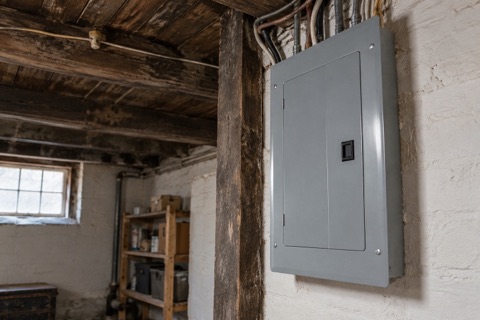
Decide what the evidence must establish
There are several different questions hidden inside is it dead. One concerns an individual visible conductor. Another concerns a particular circuit. A third concerns whether any active knob-and-tube remains anywhere in the dwelling. The third claim is much broader than the first. Explain which decision depends on the assessment and ask whether the proposed inspection can answer it. The scope should include uncertainty created by inaccessible areas or previous alterations. Homeowners should not attempt to establish absence of voltage by experimenting with wires, switching breakers at random or relying on a nonworking fixture.
Appearance records history, not status
The Indiana historic-preservation article describes old supports and wiring that may be abandoned or still in service. That is the essential visual limitation. A house may contain disconnected remnants beside active older sections, so one finding cannot automatically be extended to nearby wiring. A recent renovation invoice may explain why some conductors were disconnected, but its boundaries matter. Ask the electrician to reconcile available records with the present installation. If records are missing, say so openly rather than creating an assumed history based on wire color or apparent age.
Request a precise written finding
The NFPA 73 overview provides context for defining an existing-dwelling inspection. A useful report identifies the property, assessed locations, observed wiring and conclusions supported by the work. It should distinguish verified inactivity from places not assessed. A statement such as no active wiring observed in the accessible attic is narrower than a whole-house certification. Neither wording should be made broader to satisfy a transaction. If the insurer or energy program requires more, arrange the additional investigation instead of asking the electrician to remove an accurate limitation.
Match documentation to the recipient
The 2026 BayREN EASE Home announcement specifically discusses licensed-electrician documentation of inactive knob-and-tube. That illustrates why the receiving program’s requirements matter. It does not create a universal certification form or guarantee that one report satisfies another insurer. Ask who may sign, what areas must be addressed and whether photographs, invoices or a remediation record are needed. For a buyer, have the real estate professionals coordinate access and timing. For a renovation, give the assessment to the trade whose work depends on knowing that the wiring issue is resolved.
Keep electrical status separate from physical removal
Once wiring is professionally decommissioned, a separate question remains about whether remnants must be removed. The answer depends on applicable requirements, the project scope, future work and the recipient’s conditions. Do not assume that cutting out visible sections is the required proof of inactivity, or that leaving everything behind always satisfies the goal. The electrician and relevant authority should determine the appropriate result. Homeowners should retain the record so the next person entering the attic does not have to guess whether old conductors were intentionally abandoned or simply overlooked.
Distinguish a completed assessment from a promise to assess
A proposal stating that remaining wiring will be checked is not the report showing that the check occurred. Request the final document and any exclusions, especially if an earlier invoice is being used during a sale. If the professional could not complete the planned investigation, that limitation should remain visible. The date also matters: a report predating later electrical alterations cannot automatically establish the condition after them. Keep the sequence of assessment, changes and final findings clear for the recipient.
A practical example
Hypothetical example: An attic contractor sees several old wires and postpones insulation. The homeowner has a five-year-old invoice saying upstairs electrical updated. A new electrical assessment finds inactive remnants in one accessible area but cannot establish the status of wiring entering a finished knee-wall space. The homeowner needs the uncertainty resolved before the insulation project can rely on inactivity. If an energy program will review the documentation, its requirements should be obtained before the follow-up visit. The eventual record can distinguish what was inspected, what remediation occurred and what was verified afterward. This costs more effort than accepting a reassuring photograph, but it produces evidence tied to the actual project rather than an unsupported whole-house assertion.
Questions to resolve before deciding
- Define whether the question concerns one conductor, an area or the entire dwelling.
- Ask the receiving insurer or program what documentation it requires.
- Request findings and access limitations in the electrician’s report.
- Keep nonworking fixtures and switched-off lights out of the evidence of inactivity.
- Retain decommissioning records separately from any physical-removal invoice.
Frequently asked questions
Does a non-contact tester settle the question for a homeowner?
No single homeowner observation should be treated as a comprehensive absence-of-voltage or whole-house determination. Correct testing, identification of sources and interpretation belong to qualified electrical work. This article addresses evidence and documentation rather than teaching testing on old conductors.
Does inactive mean the old wire has to disappear?
Not necessarily. Electrical decommissioning and physical removal are separate outcomes. Ask the electrician, relevant authority and the party relying on the result what is required for this project. The documentation should be explicit enough that remaining remnants do not create a new misunderstanding.
Sources and further reading
- Lighting it up
- NFPA 73: Electrical Inspections for Existing Dwellings
- Knob-and-tube rebates help Bay Area homes with EASE Home upgrades
Questions from homeowners
These discussions helped identify the problem. Reddit experiences are anecdotal; technical and legal statements rely on the sources above.