Begin with the problem being solved
A homeowner may be concerned about deteriorated insulation behind a light, an outlet near water, a tripping breaker or a missing equipment ground. These observations belong in the same electrical assessment, but they do not all have the same remedy.
The CPSC Guide to Home Wiring Hazards guide distinguishes arc-fault and ground-fault protection. That distinction helps keep a proposal honest. If the concern is a damaged connection, adding a device does not make the connection sound. If the concern is shock protection, an arc-fault feature should not be presented as the same function.
| Function | Main question it addresses | Important limitation |
|---|---|---|
| Overcurrent protection | Is current excessive for the protected circuit under the device characteristics? | Does not provide every form of arc-fault or personnel ground-fault protection |
| AFCI | Are certain hazardous arcing signatures present? | Does not repair an arcing connection |
| GFCI | Is a ground-fault imbalance being detected? | Does not add an equipment ground |
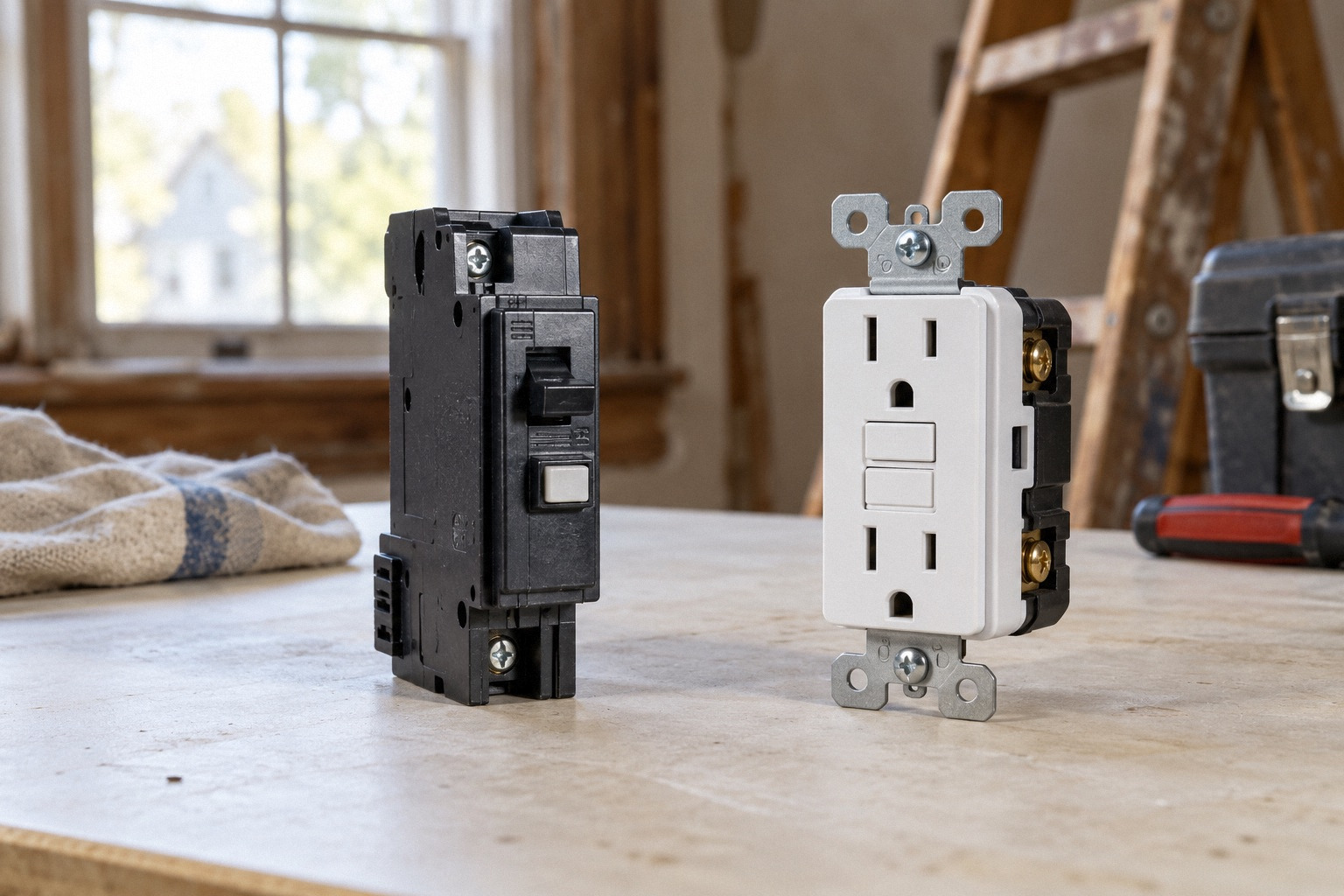
| Dual-function AFCI/GFCI | Both listed protective functions in one device | Still requires a suitable circuit and compatible installation |
The ordinary breaker remains part of the picture
Owners sometimes assume that a new protective device replaces every function previously associated with the circuit. In practice, the complete arrangement still has to provide the required circuit protection through correctly selected equipment. A receptacle-level protective device and a breaker-level product occupy different positions in that arrangement.
Ask what each component does and which portion of the circuit it covers. A plain-language explanation is enough: where protection begins, which outlets depend on it and how the branch is otherwise protected. The goal is understanding the design, not memorizing every product label.
Combination and dual function are easy to confuse
Marketing terms can sound similar while describing different features. Do not assume that the word combination means both AFCI and GFCI protection. Read the actual product designation and documentation for the selected device.
This is a useful place to request a model number rather than a generic description such as safety breaker. A model number makes compatibility and functions checkable. It also prevents later substitutions from being treated as identical when the replacement product provides a different set of protections.
Older circuit arrangements matter
Old houses may contain legitimate shared-neutral branches, undocumented borrowed neutrals or later alterations whose relationships are not yet clear. These conditions need investigation before selecting protective equipment.
Schneider's Can two single-pole protective breakers feed circuits sharing a neutral? describes limitations for particular single-pole breaker families and identifies circumstances where a suitable two-pole product may be considered. That is product-specific guidance. It supports neither the claim that AFCI protection is impossible in every old house nor the claim that any new protective breaker can be fitted without evaluating the circuit.
Missing grounding is another separate question
A GFCI-protected replacement arrangement may be relevant where an existing receptacle has no equipment grounding conductor. But that arrangement does not create an equipment ground, and it must be understood with its required labeling and limitations.
Leviton's Leviton 223 non-grounding receptacle page explains the replacement concept. Because it includes an older code citation, the current adopted requirement should be checked independently for the project. The important distinction for planning is straightforward: ground-fault protection and a grounding path are different facts that should both be stated.
A hypothetical kitchen and bedroom comparison
Imagine a house with a modern kitchen circuit and an older bedroom circuit. The kitchen has an outlet location where ground-fault protection is relevant. The bedroom branch has an uncertain shared-neutral arrangement and a deteriorated fixture connection.
It would be weak planning to prescribe the same device everywhere and call the house upgraded. The kitchen arrangement should be checked against its location, equipment and applicable requirements. The bedroom needs its wiring condition and neutral relationships resolved before a compatible protective arrangement is selected. The two rooms may ultimately use similar-looking products for different reasons.
Protection coverage should be explicit
A device's physical location does not tell the homeowner everything about its coverage. An upstream protective arrangement may serve several outlets, while another nearby outlet belongs to a different branch. Old additions make those relationships particularly easy to misread.
Ask for a simple description of the outlets or circuit sections associated with each protective device. Include places where a reset may be necessary, especially if the device is located outside the room it serves. This is practical operating information, not an invitation to open boxes or trace energized conductors.
Treat trips as information
Repeated trips should lead to diagnosis rather than automatic removal of the protective feature. Possible causes differ with the device and circuit. A homeowner's description of when the trip occurs can help: one particular appliance, a certain lighting operation or an apparently unrelated room.
Keep that observation factual. “Trips when the vacuum starts in the hall” is more useful than “the AFCI is defective.” Do not repeatedly reset a circuit with signs of damage or improvise bypasses. The electrician can use the observation alongside product diagnostics and circuit testing.
Code triggers depend on the work
Existing installation, receptacle replacement, circuit extension and new branch wiring may involve different requirements. A national article cannot reduce those distinctions to “every old house must immediately receive every new device.”
California projects need the applicable state code edition and local amendments considered for the actual scope. The same caution applies elsewhere in the United States. Ask which requirement applies to the work being done and which additional protection is being recommended as a design choice.
Choose a complete explanation
A strong recommendation identifies the hazard, the circuit condition, the product and the coverage. It also explains any work needed to make the circuit suitable for that product. This makes competing recommendations easier to assess without assuming that the most complicated label is automatically best.
For an older home, the useful outcome is a coherent protective system paired with sound wiring. AFCI, GFCI and dual-function equipment can each have a role, but the acronym is only the beginning of the design conversation.
Your project checklist
Questions that come up next
Is a combination AFCI necessarily a dual-function AFCI/GFCI?
No. Similar terminology can refer to different features. Check the exact product designation and documentation.
Does adding a protective breaker fix damaged wiring?
No. Damaged insulation, connections and other defects require their own assessment and correction.
Sources and further reading
- CPSC Guide to Home Wiring Hazards
- Can two single-pole protective breakers feed circuits sharing a neutral?
- Leviton 223 non-grounding receptacle
Questions from homeowners
These discussions helped identify the problem. Reddit experiences are anecdotal; technical and legal statements rely on the sources above.