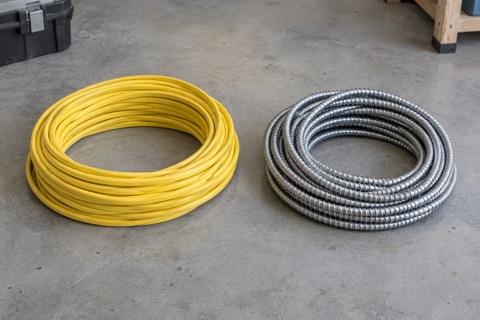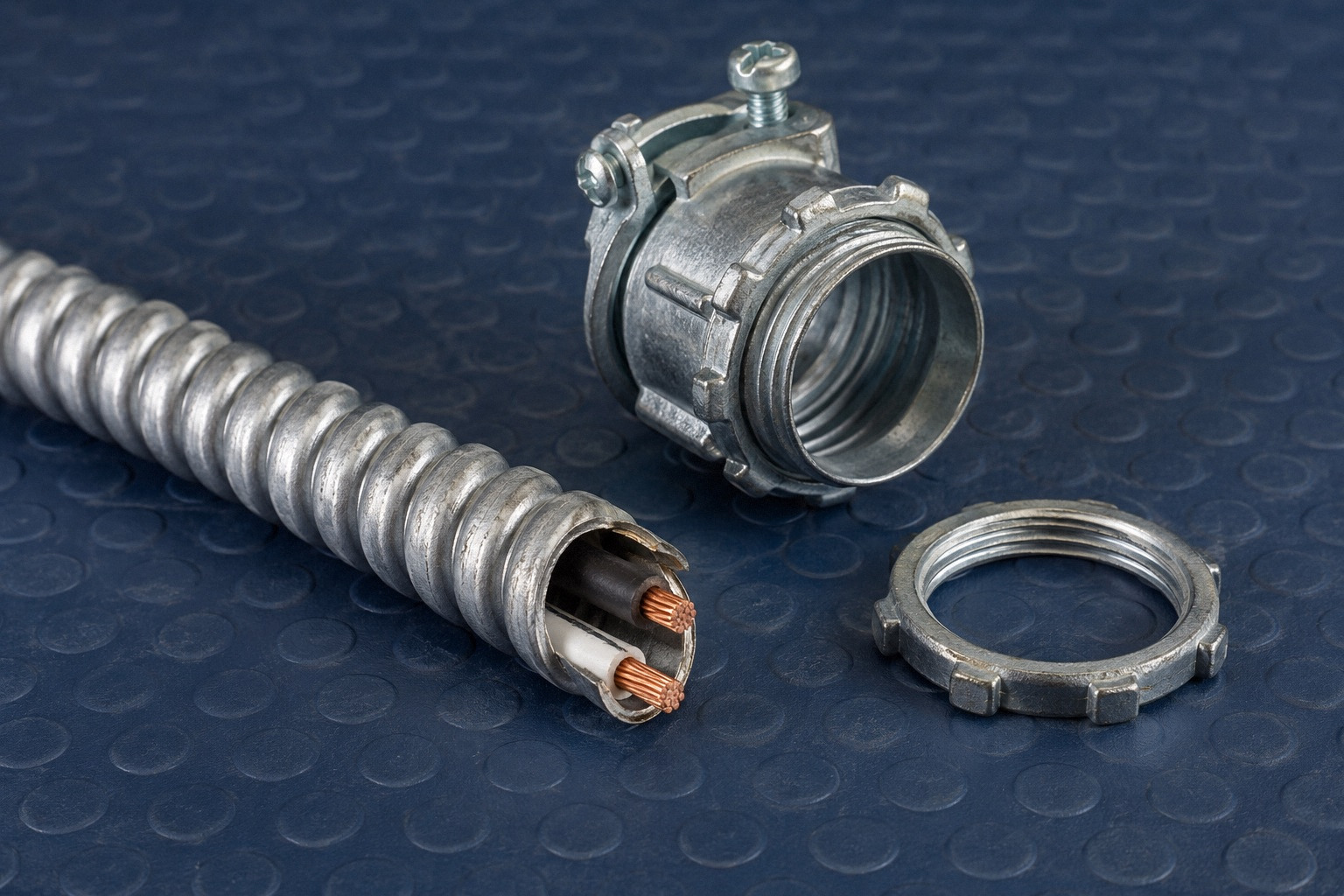
Why the jacket creates confusion
Older homes accumulate wiring terminology from different decades and different trades. An owner may call every flexible metal jacket BX; a contractor may use the same term loosely while referring to a particular modern product. That shorthand becomes a problem when the conversation moves from appearance to grounding.
A cable name should lead to a specific construction and approved installation method. If the cable cannot be identified sufficiently, the uncertainty should remain explicit. Guessing the grounding arrangement from a familiar spiral shape can create false confidence at every downstream receptacle.
Grounding is a complete path
Equipment grounding concerns the intended path that helps a protective system respond to certain electrical faults. It is not simply a piece of metal near an outlet. Every relevant part of the route must support the intended function, including connections between cable, fittings and boxes.
A sound-looking receptacle at one endpoint cannot establish the condition of a concealed upstream connection. Nor can a newly installed metal box repair an unsuitable pathway farther back. This is why an electrician may need to investigate more than the device the owner originally asked about.
Modern metal-clad cable (MC) does not describe all legacy armor
Southwire distinguishes conventional MC constructions with a grounding conductor from specifically listed armor-based grounding assemblies. In a listed MCAP construction, copper circuit conductors and an aluminum grounding/bonding component can coexist. An aluminum jacket or bonding component therefore does not establish that the current-carrying branch conductors are aluminum. Conversely, an unidentified old jacket cannot inherit the listing of modern MCAP. See Southwire MC Cable Products Installation Guide.
For an old-house assessment, that information provides a useful comparison: identify the actual assembly, then determine which requirements apply to it. It should not be used to retrofit a modern product explanation onto a cable whose markings, age and construction remain uncertain.
A small metal strip may have a different role
Owners sometimes discover a thin strip or conductor alongside the insulated wires and assume it can be treated like a modern grounding conductor. Its intended role depends on the cable construction. Its presence alone does not establish what may be connected to it or how a termination should be made.
The safe planning response is to preserve the observation and have the cable assessed. A photograph can help describe the question, but it may not show enough to answer it. Do not pull the strip out, repurpose it or assume a connection method from a visually similar online example.
A tester result is not the entire answer
A receptacle test can reveal certain faults, yet it does not replace an assessment of the concealed grounding path. The result describes what the instrument detected under its test conditions. The electrician still needs to interpret that result alongside the wiring method and the condition of its connections.
This distinction matters when an owner sees a reassuring display and concludes that every armored branch is sound. CPSC's CPSC Guide to Home Wiring Hazards treats wiring condition and protective measures as practical safety questions. A narrow screening result should not be promoted into a whole-circuit certification.
ground-fault circuit interrupter (GFCI) protection answers a different question
If an equipment ground is absent, a permitted GFCI-protected replacement arrangement may be relevant to an existing receptacle. But it does not create a grounding conductor or validate old armor. Leviton's Leviton 223 non-grounding receptacle page describes replacement and labeling concepts; its older code reference should not be used as the current section number for a project.
Keep the two conclusions separate: whether a ground-fault protective device is provided, and whether an equipment grounding path is present. A device may address one concern while another equipment requirement or wiring defect remains unresolved.
A hypothetical room with mixed boxes
Imagine a bedroom with three metal outlet boxes. One is supplied by a documented modern cable, one by an unidentified older armored run, and the third by a later extension whose route is unknown. All three have matching new faceplates.
Their visual consistency does not mean their grounding arrangements are identical. The assessment should treat each branch relationship as evidence to establish. It may confirm one, require repairs to another and leave the extension pending further tracing. Replacing every receptacle with the same model would not resolve those distinctions.
What to request from an assessment
Ask the electrician to identify the cable system where possible, explain the intended grounding path and state whether its relevant connections have been verified. If the route cannot be fully established, ask what remains unknown and what options exist for correcting that uncertainty.
Useful outcomes might include repair of a suitable system, provision of a new approved grounding arrangement or replacement of an unsuitable branch. The correct option depends on the actual installation. The homeowner's role is to understand the conclusion and its limits, not to perform continuity testing inside energized equipment.
California and practical equipment needs
The adopted code and local amendments determine which methods are permitted for the work being performed. Equipment instructions may also require a grounding arrangement that cannot be supplied by an ungrounded replacement receptacle. An apparently convenient device substitution therefore needs to be checked against both the wiring and the intended load.
A finished explanation should avoid two extremes: declaring all old metal cable grounded, or declaring all armor useless. Both skip the evidence that matters. The defensible answer names the assembly, evaluates its path and explains what must change before the circuit is relied upon for its intended use.
Your project checklist
Questions that come up next
Does a metal outlet box prove the outlet is grounded?
No. The box must be part of a suitable verified grounding path; its material alone establishes nothing.
Can a GFCI make an uncertain armored cable grounded?
No. Ground-fault protection and an equipment grounding path are different functions.
Sources and further reading
- Southwire MC Cable Products Installation Guide
- CPSC Guide to Home Wiring Hazards
- Leviton 223 non-grounding receptacle
Questions from homeowners
These discussions helped identify the problem. Reddit experiences are anecdotal; technical and legal statements rely on the sources above.