Define which aluminum system is under discussion
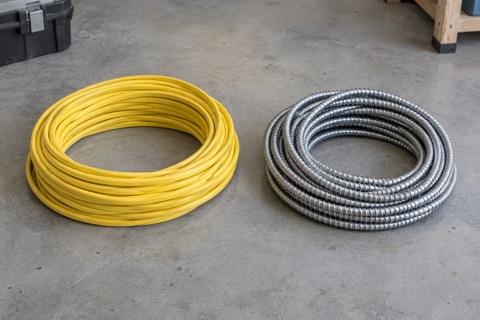
“Aluminum wiring” is too broad a label for a useful repair decision. An old house might contain legacy small branch conductors, modern larger conductors serving equipment, copper-clad material or even tinned copper that looks silver at a glance. These are not interchangeable cases.
This article concerns confirmed legacy aluminum branch circuits of the kind addressed in CPSC Publication 516. Identification should be resolved by a qualified electrician before selecting a remedy. An owner should not cut or scrape an unknown conductor to settle a visual disagreement. The point is to define the scope accurately, not to turn a material question into unnecessary disturbance.
What the federal publication supports
CPSC Publication 516 addresses legacy small aluminum branch conductors and identifies complete copper replacement, COPALUM and AlumiConn within its stated recommendations. COPALUM uses a specialized crimp system and trained installers; AlumiConn is a different connector method, not a generic permission for any copper pigtail. The publication excludes larger aluminum service, dryer and range circuits from these repair recommendations. See Repairing Aluminum Wiring, Publication 516, June 2011.
That document is dated June 2011. It remains useful as a clearly identified source, but its historical statistics should not be retold as a current probability that a particular house will catch fire. A connection-temperature study is not a direct house-fire forecast. The homeowner needs a repair decision grounded in the installation now present.
Replacement changes more than the conductor
Complete copper replacement can address the conductor issue while also creating an opportunity to redesign circuit distribution, outlets and routes. That broader benefit matters when a house already has poorly arranged circuits or insufficient connections for its intended use.
However, replacing the branch system is a larger intervention in the building. Finished walls, inaccessible fixtures and later additions affect the route choices. The comparison should therefore describe what the replacement would accomplish beyond changing metal, and which access assumptions it relies upon. Otherwise, unlike scopes can be mistaken for competing versions of the same remedy.
Connection remediation needs complete boundaries
A connection-based remedy depends on finding and addressing the relevant connections, not just the most visible receptacles. Fixtures, switches, junctions and directly connected equipment can be part of the problem. A room with new outlets may still contain an unaddressed connection elsewhere on its branch.
Ask how the electrician will establish the extent of the system and identify concealed or difficult-to-access connection points. If some remain unknown, that limitation belongs in the conclusion. A small completed repair can be valuable, but it should not be described as comprehensive when the remaining system has not been established.
Product names do not replace qualified installation
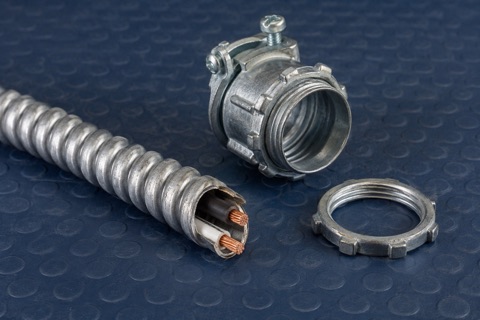
Remediation methods have specific components, tools and installation requirements. The presence of a branded connector is not enough to prove correct application. An incompatible combination or an incomplete installation cannot be made satisfactory by borrowing the reputation of the method.
The CPSC publication explains important limitations, including specialized training associated with COPALUM. For a current project, the selected method also needs current manufacturer documentation and appropriate installer competence. This article intentionally does not provide a connection-making procedure; small errors in this work can defeat the purpose of the repair.
A hypothetical mixed-condition house
Consider a house whose living-room branches are confirmed legacy aluminum, while the kitchen was fully rewired during a documented renovation. The owners now plan an office with additional equipment and want to preserve original living-room plaster.
One option might focus on a complete assessed remedy for the retained living-room circuits while adding a separately designed office circuit. Another might replace the affected branches because route access is now practical. The kitchen's modern circuits should be evaluated on their own condition rather than automatically included merely because the house contains aluminum elsewhere.
Compare the building impact honestly
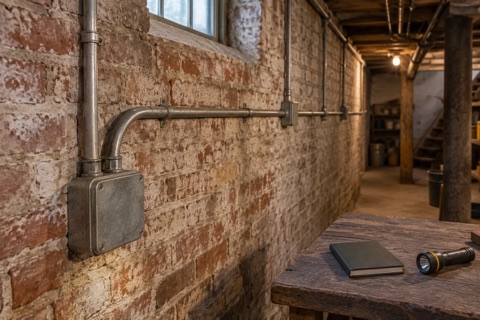
Preserving finishes is a legitimate design objective, but it should not become a reason to accept an incomplete electrical remedy. The Standards for Treatment of Historic Properties: Preservation and Rehabilitation guidance encourages minimizing alteration to significant features. It does not declare that every concealed system must remain in place.
A practical comparison can identify which routes use secondary spaces, which fixtures need access and where localized openings may be necessary. A connection-remediation approach can also require access. Describing it as inherently disturbance-free would hide the work needed to find and address the relevant endpoints.
Symptoms do not define the entire risk
A circuit that appears to work normally has not thereby passed an assessment. Equally, flickering or an inoperative outlet should not be diagnosed as an aluminum-specific defect without investigation. Several faults can produce similar symptoms.
The CPSC Guide to Home Wiring Hazards guide supports treating wiring problems as conditions to evaluate rather than excuses for repeated resets or continued use. If there is burning odor, visible damage or another urgent sign, the immediate response should follow professional safety guidance. The longer-term material remedy is a separate decision after the immediate concern is addressed.
A useful technical comparison
Ask for two clearly bounded descriptions where both options are feasible: what would be replaced, and what would be retained under a specified remediation method. Each should state how the remaining branches and connections are accounted for. The comparison should also identify additional goals such as new equipment or changed circuit distribution.
For California, the completed work must follow the locally applicable electrical requirements and product instructions. Neither a national guidance document nor a generic online endorsement resolves every existing condition. The strongest decision is the one that addresses the confirmed system comprehensively and states any remaining uncertainty plainly.
Your project checklist
Questions that come up next
Are all aluminum conductors covered by this guidance?
No. CPSC Publication 516 addresses particular legacy branch-circuit concerns and excludes larger aluminum circuits from its repair recommendations.
Do copper pigtails prove the house has been remediated?
No. The method, installation quality and completeness of the connection scope must be established.
Sources and further reading
- Repairing Aluminum Wiring, Publication 516, June 2011
- Standards for Treatment of Historic Properties: Preservation and Rehabilitation
- CPSC Guide to Home Wiring Hazards
Questions from homeowners
These discussions helped identify the problem. Reddit experiences are anecdotal; technical and legal statements rely on the sources above.