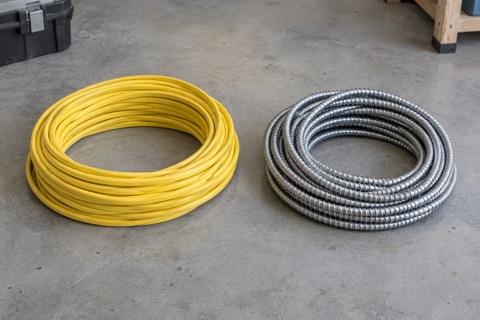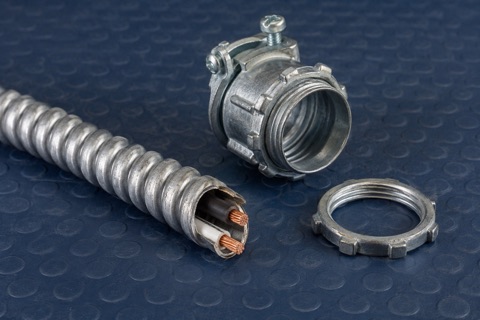
Separate the raceway from its contents
Owners often use conduit, cable and wire as if they mean the same thing. A raceway is a pathway; the conductors or cable inside it are a separate part of the electrical installation. Their requirements interact, but one does not substitute for the other. That distinction becomes important when someone proposes removing old conductors and installing whatever happens to be available.
Southwire identifies THHN/THWN-2 as a dual-rated conductor product: the THHN application is dry-location use, while its THWN-2 rating covers wet or dry locations up to the stated 90°C limit, subject to the complete installation. Those markings identify insulation applications; they do not establish raceway fill or circuit ampacity by themselves. See SIMpull THHN/THWN-2 Copper.
Understand where the route really goes
An old house may contain a conduit run that once served a room with a different layout. A visible section can disappear behind an addition, change direction in an inaccessible space or arrive at a box whose purpose is unclear. Reuse should begin with a route description that acknowledges those gaps.
Ask which portions were observed directly and which are inferred. A sketch can use solid lines for confirmed sections and dashed lines for unknown ones. This simple distinction makes later decisions easier: a route can be attractive in principle while still requiring investigation before it is selected for a new circuit.
Condition is more than appearance
A clean-looking exposed length tells you little about hidden bends, damaged sections or an inaccessible termination. Conversely, an old finish on the outside does not by itself establish that a raceway must be replaced. The useful assessment focuses on the conditions that affect the proposed use.
Relevant questions include whether the pathway is continuous, whether its connections are appropriate, whether physical damage is present and whether water or corrosion has affected the route. The professional should explain how any uncertainty changes the recommendation. “It has always been there” is a history statement, not a performance test.
Capacity depends on the intended circuit
A raceway that accommodated the former wiring may not accommodate the new conductor arrangement. New grounding provisions, additional conductors, different insulation dimensions or a changed circuit layout can alter the design. A nominal diameter therefore does not answer the reuse question by itself.
The homeowner does not need to perform raceway-fill calculations to make progress. Instead, identify the intended endpoint and equipment, then ask the electrician to document whether the proposed conductor set fits the selected pathway and its operating conditions. Avoid purchasing conductors before that design is established.
Pulling tools do not remove uncertainty
A fish tape can help with an appropriate route, but it is not a tool for proving that an unknown electrical path is safe to explore. Klein explicitly warns against using fish tapes on or near live circuits, including its fiberglass product. See Klein 56380 fiberglass fish tape. A nonmetallic body should never be interpreted as permission to work around energized conductors.
The planning question is whether the circuit can be made safe and the route evaluated before any pulling activity. If the answer depends on unverified old connections, the investigation must resolve them. Forcing a tool or a new conductor through resistance can turn an uncertain route into a damaged installation.
A hypothetical preserved hallway
Consider a hallway with original plaster and an old raceway running between an accessible basement box and an upstairs service closet. The endpoints look promising. Between them, however, the route passes through a remodeled landing. The owner hopes to use it for a new branch circuit without disturbing the hallway.
There are at least three possible outcomes. The raceway can be verified and reused; part can be retained while an unsuitable section is replaced; or a different route can prove more practical. None of those outcomes should be promised from endpoint photographs. The value of the investigation is discovering which option preserves the hallway without inheriting an unknown defect.
Compare reuse against realistic alternatives
The alternative to reuse is not necessarily opening every wall. A new route may follow secondary spaces, use an existing service zone or accept a short visible section. The historical The Rehab Guide, Volume 7: Electrical/Electronics discusses rehabilitation approaches, but its age means it should inform options rather than supply current installation rules.
A useful comparison considers damage to finishes, confidence in the path and long-term access. Reuse that requires repeated uncertain attempts may be less attractive than a deliberately placed new route. On the other hand, a well-understood raceway can be a valuable asset in a finished house.
Environmental changes matter
A route that begins indoors may enter an exterior wall, underground section or other location where moisture conditions differ. The new conductor choice must follow the actual environment. Do not assume that a protective-looking raceway makes every material inside suitable for every condition.
Similarly, a house addition can change how a previously exposed route is enclosed or accessed. Tell the electrician about known remodeling, flooding or water entry along the path. These observations help establish the questions that need answering; they do not require the owner to open boxes or test conductors.
What a sound reuse conclusion contains
A useful conclusion identifies the route, the portions assessed, the proposed conductor arrangement and any limitations. It also explains what would trigger a change of plan, such as an inaccessible obstruction or a mismatch between the intended circuit and the available pathway. This makes the decision reviewable without pretending that concealed conditions are already known.
For California and other US jurisdictions, the adopted electrical requirements and applicable local amendments still govern the completed installation. Manufacturer information supports the selected components; it does not replace that local design check. Reusing conduit is successful when it preserves a verified pathway, not simply when old material remains in place.
Your project checklist
Questions that come up next
Does empty conduit mean it is ready for new wiring?
No. Its route, condition, connections, capacity and environmental suitability still need assessment.
Can new conductors be chosen before the conduit is checked?
Premature purchasing can lock the project into the wrong conductor arrangement. Establish the equipment needs and pathway suitability first.
Sources and further reading
- SIMpull THHN/THWN-2 Copper
- Klein 56380 fiberglass fish tape
- The Rehab Guide, Volume 7: Electrical/Electronics
Questions from homeowners
These discussions helped identify the problem. Reddit experiences are anecdotal; technical and legal statements rely on the sources above.