Start with a question the camera can answer
“Look inside the wall” is too broad to guide a useful survey. Better questions are whether a proposed turn is blocked, whether two cavities align or whether an existing opening reveals enough room for further assessment.
Each question should connect to a decision. If the image confirms an obstruction, the route may change. If it shows only insulation, the result may remain inconclusive. The survey becomes efficient when every view has a purpose rather than generating a large collection of ambiguous pictures.
Camera size affects access
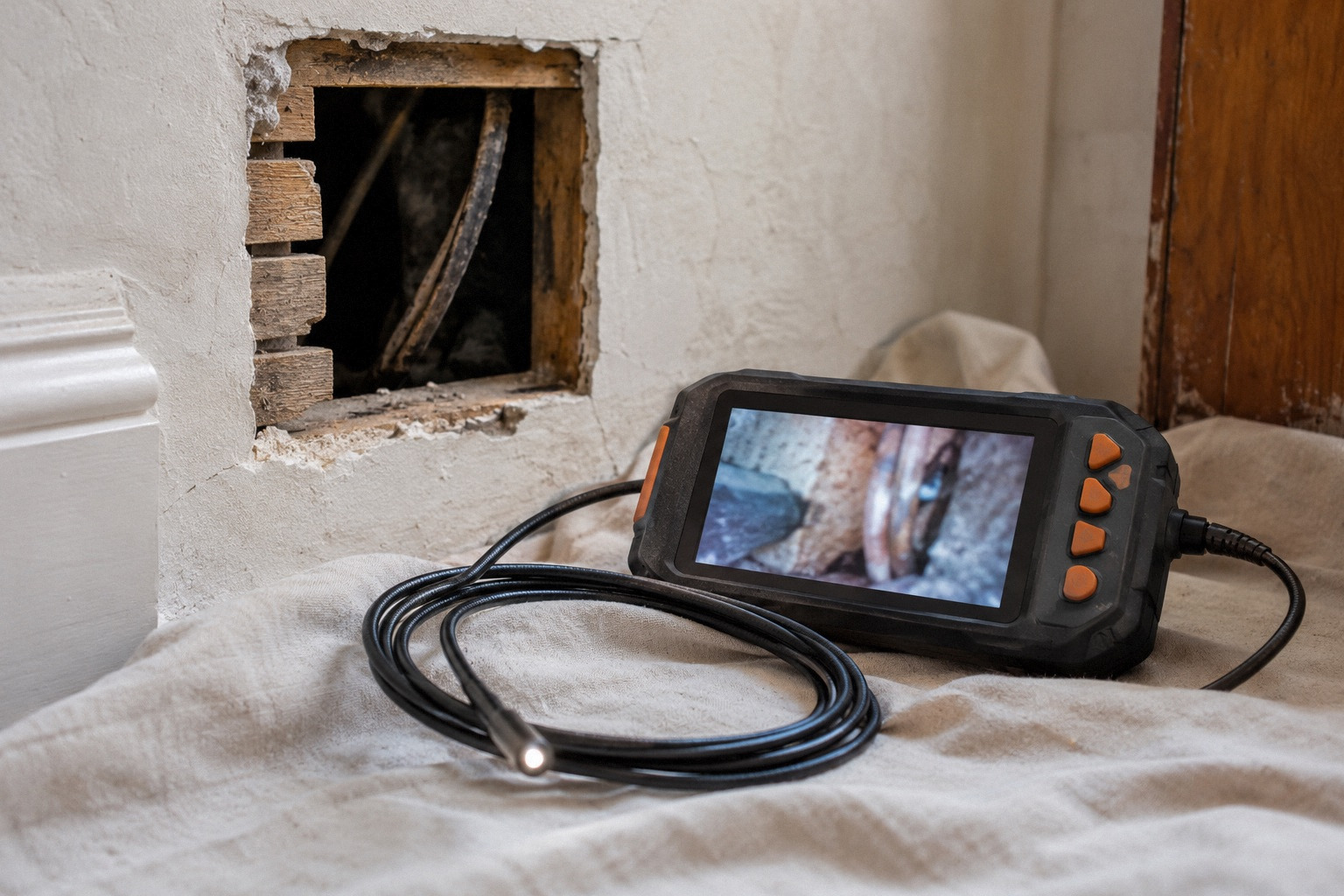
Klein's Klein ET500 video borescope describes the ET500 with a 17 mm camera head and a gooseneck arrangement, along with recording functions. The head size is a real planning constraint: a camera cannot pass through an opening smaller than its assembly permits.
A smaller camera may reach places the larger one cannot, but size alone does not establish image quality or suitability for the environment. Tool selection should follow the specific investigation. Do not enlarge an important finish opening merely because the available camera happens to be too large.
The image shows surfaces, not everything behind them
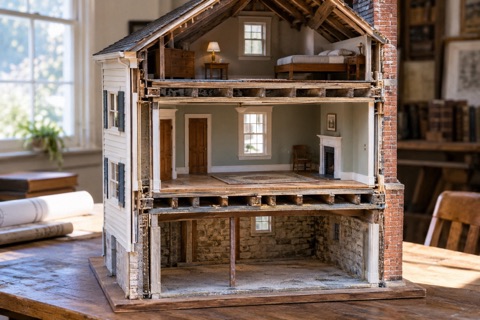
A view of the cavity may reveal one side of a cable, a piece of framing or a pipe. It may not show the far side, the next compartment or the concealed connection beyond the bend. The apparent scale can also be misleading without a known reference.
Record the access point and viewing direction alongside the image. A picture without that context may be difficult to interpret later. Describe what is seen literally before inferring what it means for the route.
A camera and a circuit tracer answer different questions
A borescope provides visual information. A tracer can help investigate electrical or pathway relationships using its own operating method. Klein's Klein ET450 circuit breaker finder and wire tracer describes a transmitter-and-receiver tool capable of professional tracing in several conditions.
Neither tool replaces the other. Seeing a cable does not establish which circuit it serves, while detecting a tracing signal does not reveal every physical obstruction. Combining appropriate methods can produce a stronger assessment, but the result still needs qualified interpretation.
De-energized investigation is a boundary
The ET500 documentation warns against use on energized circuits. That matters even when the owner thinks the camera is merely plastic or insulated. Unknown cavities can contain more than the circuit shown on the room label.
The safe work arrangement must be established by the person performing the investigation. This article does not provide a live-probing procedure. A camera should reduce unnecessary building disturbance, not create a new electrical exposure while trying to avoid an access hole.
A hypothetical blocked wall
Imagine a proposed route from a basement toward an upstairs outlet. A limited camera view from an appropriate existing access point shows a horizontal obstruction. The image does not establish the obstruction's structural role or whether another cavity is clear.
A useful report would say what was observed and how it affects the proposed path. It would not authorize drilling through the obstruction from the image alone. The next decision might involve a different route, additional assessment or a carefully selected access location.
Record uncertainty explicitly
Use three categories in the survey notes: confirmed observation, interpretation and unresolved question. For example, a visible pipe is an observation; the belief that it continues through the next cavity is an interpretation; its relationship to the desired route may remain unresolved.
This format prevents a tentative impression from becoming an assumed fact later in the project. It also helps another professional understand why a route was selected or rejected without needing to repeat every earlier observation.
Access itself can damage plaster
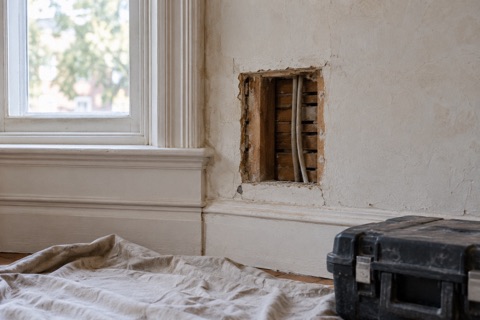
A camera may require little space, but the opening used to admit it still interacts with the finish. Historic plaster condition can affect how much disturbance is appropriate. The NPS Preservation Brief 21: Repairing Historic Flat Plaster discusses assessment and repair principles for that material.
Consider existing access before creating new openings. Where new access is necessary, select the location in relation to both the investigation and the finish. A tiny hole in a delicate pattern may be more consequential than a slightly larger opening in a plain, repairable surface.
What the camera cannot certify
A borescope should not be used to declare an entire branch circuit safe, free of hidden splices or suitable for a new load. Those conclusions require evidence beyond a few visual snapshots.
Likewise, it cannot identify every suspect building material reliably by appearance. If the survey encounters material that may require specialized assessment, the route investigation should respect that boundary. Better visibility does not turn a visual guess into a laboratory result.
A useful survey deliverable
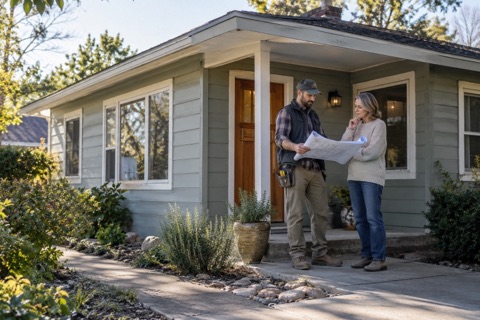
The owner should receive a concise record of access locations, representative images, confirmed obstructions and the route decisions they support. A few well-captioned images can be more useful than a long video with no orientation.
California and other local requirements still apply to any resulting electrical and building work. The borescope's contribution is evidence that can reduce unnecessary disturbance. Its success should be judged by the quality of the decisions it supports, not by a promise that a camera can make every old-house route transparent.
Your project checklist
Questions that come up next
Can a camera prove there are no hidden splices?
No. It only shows the surfaces within its accessible field of view.
Does a camera replace circuit tracing?
No. Visual inspection and tracing answer different questions and may need to be combined by a qualified professional.
Sources and further reading
- Klein ET500 video borescope
- Klein ET450 circuit breaker finder and wire tracer
- Preservation Brief 21: Repairing Historic Flat Plaster
Questions from homeowners
These discussions helped identify the problem. Reddit experiences are anecdotal; technical and legal statements rely on the sources above.