Replace the all-or-nothing question
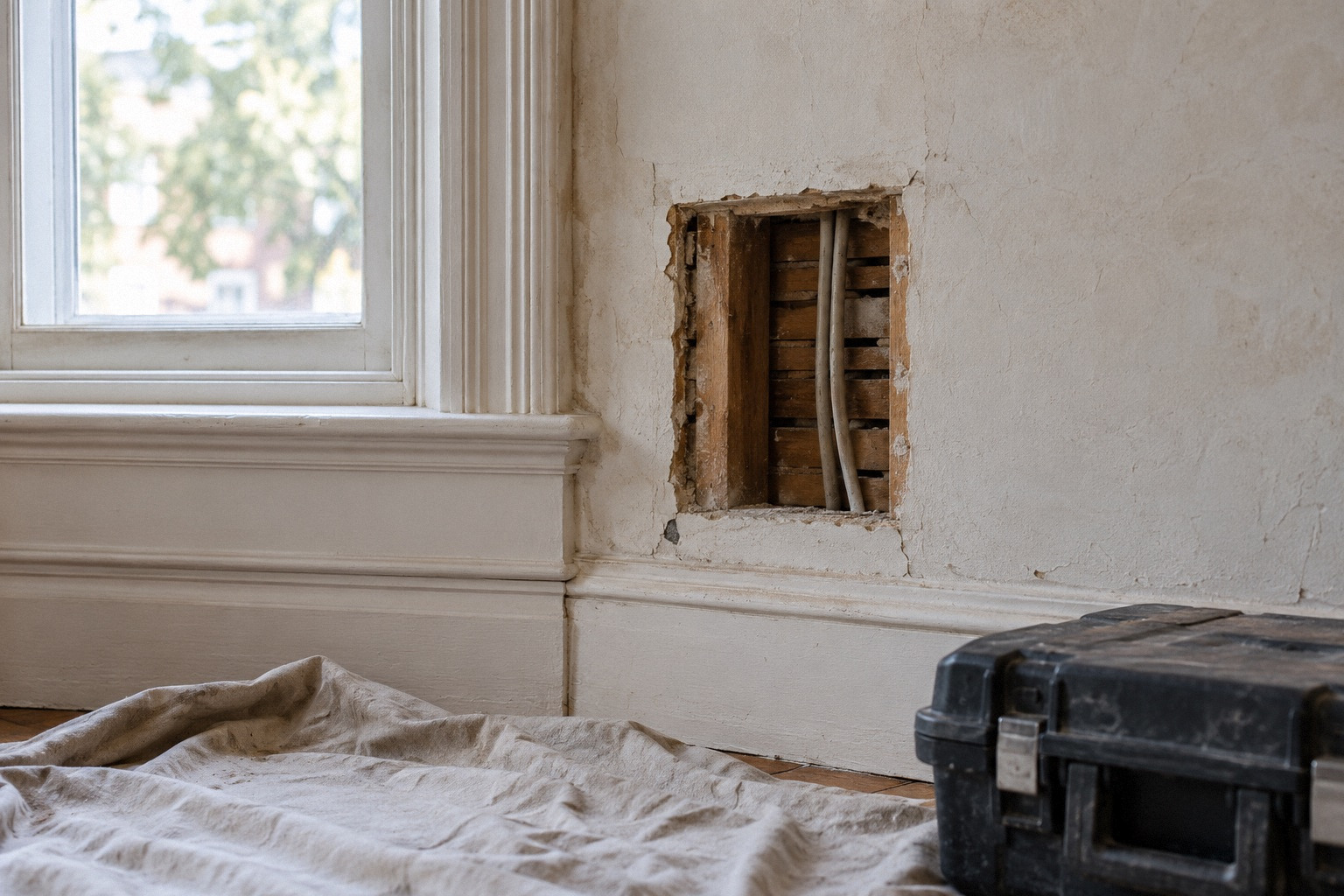
“Will you have to gut the house?” is understandable, but it bundles many decisions into one frightening image. A rewire contains individual paths to outlets, switches and fixtures. Some may be easy to reach; others may require localized openings.
Ask which areas are likely to need access and why. A room-by-room route discussion is more useful than a whole-house promise. It also helps distinguish an unavoidable opening at one difficult endpoint from a broad assumption that every wall must be stripped.
Assess the plaster before using it as an access surface
Historic plaster can be sound, cracked, detached from its support or affected by previous repairs. These conditions change how disturbance should be planned. A small intervention in unstable material can produce a larger repair than expected.
The NPS Preservation Brief 21: Repairing Historic Flat Plaster discusses preserving and repairing historic flat plaster. Its practical relevance here is that plaster deserves an assessment of its own. An electrical route should not be selected without considering the condition of the finish that will be disturbed.
| Access option | Main opportunity | Main uncertainty |
|---|---|---|
| From an unfinished space below | Reach lower-wall endpoints while avoiding prominent room finishes | Framing direction and the turn into the wall |
| From an accessible space above | Approach upper-floor lighting and wall cavities | Insulation, obstructions and the condition of the ceiling endpoint |
| Selective room-side opening | Expose a specific difficult transition | Finish stability, paint hazards and repair boundaries |
Find the route from the building, not a generic diagram
An accessible attic may help with upper-floor endpoints; a basement may help with lower-floor ones. Between those spaces, however, later remodeling can interrupt the expected paths. A wall that looks continuous in two rooms may conceal offsets, blocking or another system.
The electrician should explain which route segments are established and which remain uncertain. Old photographs, previous remodeling records and known access panels can be useful. They supplement investigation; they do not prove that a cavity is clear.
Investigation can be targeted
A borescope may help inspect a limited area before a larger opening is chosen. Klein's Klein ET500 video borescope describes that tool and warns against using it on energized circuits. The camera provides a view, not a guarantee that the whole route is clear.
A targeted investigation should answer a particular question: whether an obstruction exists at a transition, whether a cavity aligns with another or whether a proposed endpoint is reachable. Random exploratory holes are less useful than a sequence tied to a specific routing decision.
Plan for painted-surface hazards
Older painted finishes introduce another reason to plan access before cutting. EPA's Steps to Lead Safe Renovation, Repair and Painting guidance addresses lead-safe renovation in pre-1978 housing. The age of the house does not prove every surface contains lead, but it makes casual assumptions inappropriate.
The access strategy should coordinate any needed paint-hazard assessment and covered work practices. A small opening is not automatically a complete exemption from planning. Avoid treating dust control as something to improvise after the first hole has been made.
A hypothetical front parlor
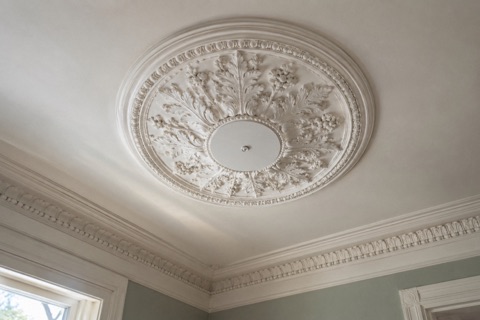
Imagine a parlor with intact original plaster, simple baseboards and a decorative ceiling. A basement provides access below most outlets, while the central ceiling fixture is harder to reach. The owner initially assumes that replacing the fixture circuit means opening the entire ceiling.
The route assessment may find a localized approach from an adjacent service area, or it may identify a carefully selected opening that avoids decoration. Another option could involve a different approved pathway. The decision is specific to the building; the useful principle is to investigate the difficult endpoint without sacrificing all the easier surfaces by default.
Count repair complexity, not just holes
Two small openings can have very different consequences. One may be in a plain wall scheduled for repainting; another may cut through patterned wallpaper or molded plaster. A promise of fewer holes can therefore be misleading if it ignores where the holes occur.
Compare the finish impact of each route. Note texture, paint boundaries, decorative features and fragile edges. The route with one additional opening in a simple secondary area may preserve more important material than a seemingly shorter approach through a prominent feature.
Keep access choices reversible where possible
Before significant disturbance, establish the intended route and its fallback. If an obstruction is discovered, the next action should follow a considered alternative rather than automatic enlargement of the opening.
This approach does not mean work must stop for every minor discovery. It means the decision boundaries are clear: which surfaces can tolerate localized access, which require preservation input and which route should be reconsidered before more material is removed. Those boundaries support efficient work while protecting the building.
What the owner can prepare
Photograph important finishes and identify surfaces that are original, recently restored or difficult to match. Gather any drawings or photographs from previous renovations. Describe future room changes so the new wiring does not need another access campaign shortly afterward.
A simple priority list helps: preserve the ceiling medallion, avoid the mural, use the plain closet wall if feasible. These are concrete design inputs. “Do no damage anywhere” is too broad to guide a real rewire.
A realistic expectation
Selective access is often a useful objective, but the final amount of disturbance depends on what the building permits. A credible plan makes that uncertainty visible and ties decisions to actual paths.
California and other local requirements still govern the electrical work, and preservation considerations do not replace them. The best outcome combines a complete electrical solution with deliberate access and appropriate finish repair. That can preserve substantial plaster without relying on a promise that concealed conditions cannot support.
Your project checklist
Questions that come up next
Can an electrician guarantee no holes before investigating?
Such a guarantee is unreliable when concealed routes remain unknown. Ask for likely access points and fallback routes instead.
Is the smallest hole always the best preservation choice?
No. Location, finish significance and repair complexity can matter more than the opening's size.
Sources and further reading
- Preservation Brief 21: Repairing Historic Flat Plaster
- Klein ET500 video borescope
- Steps to Lead Safe Renovation, Repair and Painting
Questions from homeowners
These discussions helped identify the problem. Reddit experiences are anecdotal; technical and legal statements rely on the sources above.