Name the features that matter
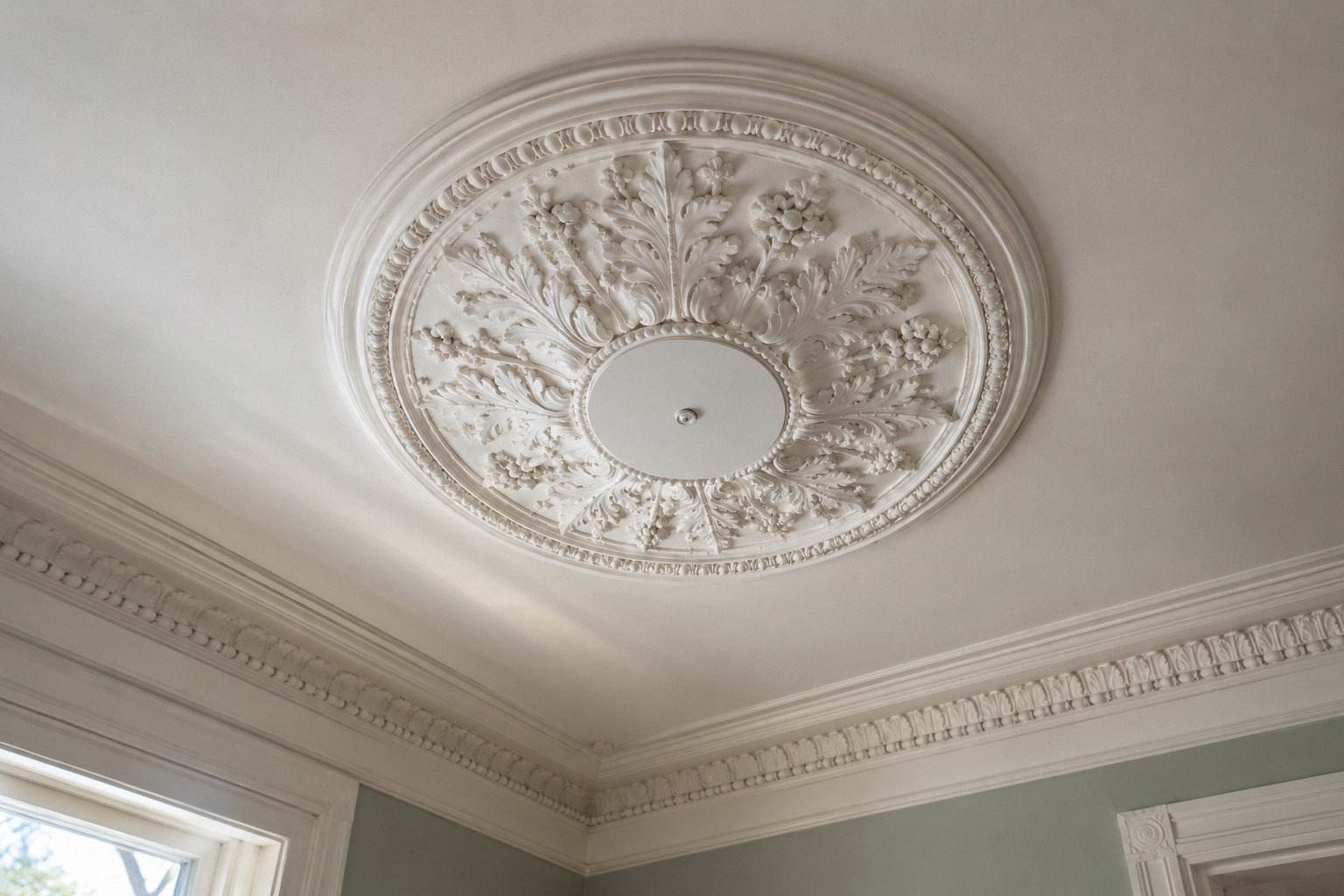
“Preserve the character” is too broad to guide a difficult fixture route. Identify the specific elements: a plaster medallion, a carved cornice, original picture rail, patterned wallpaper or a distinctive sconce surround.
Photograph them and note known repairs or fragile areas. The NPS Preservation Brief 18: Rehabilitating Interiors provides a framework for recognizing significant interior features. The practical value is turning a general wish into concrete route constraints that the electrician can discuss before choosing access points.
Condition can change the safest approach
Decorative plaster may look intact while being poorly supported or weakened by earlier water damage. A small disturbance at one edge can affect a larger area. Likewise, trim that appears removable may be brittle, heavily painted or joined in a way that makes removal damaging.
The NPS Preservation Brief 21: Repairing Historic Flat Plaster focuses on historic flat plaster, so it should not be treated as a complete manual for every ornamental feature. It nevertheless reinforces the need to understand plaster condition and repair approach. Ornamental work may require a preservation specialist with the relevant experience.
The fixture and its support are separate questions
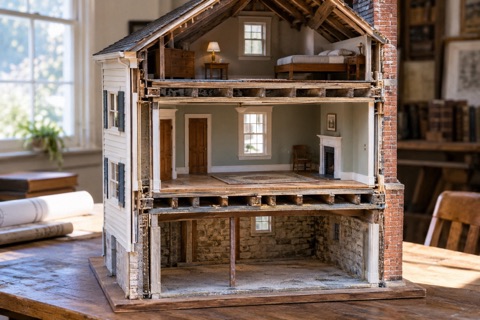
An old fixture location involves more than the visible decorative surround. The electrical connection, box and support arrangement must also be suitable for the intended fixture. A beautiful medallion cannot establish those hidden conditions.
Ask the electrician to explain what must be assessed at the endpoint and whether that assessment can occur without disturbing the significant feature. If the fixture itself is changing, provide its information early. The access needed for the existing light may differ from what a new assembly requires.
Approach from neighboring spaces when feasible
A route may be possible through an adjacent closet, a plain hallway surface or another service area. Such alternatives should be evaluated before treating the decorated ceiling as the obvious entry point.
This is not a promise that every feature can be bypassed. Concealed framing and previous alterations may limit the options. The useful question is whether the difficult endpoint has been considered from more than one direction, with the whole route in mind rather than just the last few inches.
A hypothetical dining-room medallion
Imagine a dining room with an original medallion and a later plain ceiling in the room above. The old fixture connection requires assessment, and the owner wants to retain the decorative plaster unchanged.
One option might approach the area from above, if the floor and structure permit. Another might use a localized opening outside the medallion. A third could require specialist involvement at the feature itself. The decision should follow investigation, not the assumption that the shortest physical path causes the least damage.
Crown molding can hide a difficult transition
A proposed route near the top of a wall may seem easy until it reaches a cornice. Removing that trim can affect joints, paint layers and neighboring plaster. A route that avoids the molding may require a different approach to the device below.
Discuss those transitions explicitly. The main cable run may be straightforward while the last turn into a fixture creates most of the preservation risk. Naming that risk early allows the team to compare alternatives rather than discovering it after the surrounding work is complete.
Lead-safe planning belongs before trim disturbance
Older painted trim and surrounding surfaces can introduce lead-related renovation requirements. EPA's Steps to Lead Safe Renovation, Repair and Painting explains the need for appropriate planning in pre-1978 housing.
Do not assume that removing a narrow strip of molding is automatically a trivial activity. The actual disturbance and applicable conditions matter. A preservation plan should coordinate finish protection and hazard planning so that retaining a feature does not expose occupants through poorly controlled work nearby.
Document proposed access in visual terms
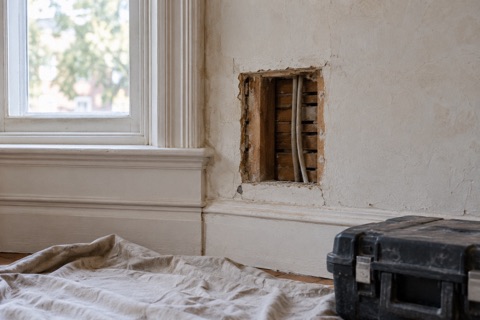
A drawing or photograph marked with proposed access areas can make the plan understandable. Identify the feature to preserve, the preferred approach and the fallback if the route is blocked.
This avoids a common misunderstanding: the owner hears “small opening” and imagines a plain wall, while the installer is thinking of a prominent decorative surface. Showing the location makes the decision concrete without requiring the homeowner to understand the entire electrical layout.
Think about repair boundaries
An opening beside a decorative feature may still require a larger paint or finish treatment to blend the repair. That does not necessarily make it the wrong choice, but it belongs in the comparison.
Ask where a repair can terminate naturally and whether the existing texture or finish is reproducible. A slightly different access location may simplify restoration substantially. These are reasons to coordinate with the person responsible for the finish before the opening is selected, especially where specialist work is involved.
Preserve the feature and complete the circuit
The preservation objective should be paired with a clear electrical outcome: the endpoint is suitable, the new route is complete and the significant material is retained wherever feasible. Neither side should be used to excuse an unresolved problem on the other.
For California and other jurisdictions, local electrical, building and any applicable historic requirements must be considered. The practical approach is feature-specific planning with explicit alternatives. It respects the house's important details while allowing the electrical work to address the reason the rewire was undertaken.
Your project checklist
Questions that come up next
Should a ceiling medallion be removed automatically to rewire a light?
No. Assess the endpoint and alternative access routes first. Some situations require specialist work, but removal should not be assumed.
Does protecting trim mean avoiding every nearby opening?
Not necessarily. A deliberate opening in a less significant surface can preserve more important material than an awkward route through the feature itself.
Sources and further reading
- Preservation Brief 18: Rehabilitating Interiors
- Preservation Brief 21: Repairing Historic Flat Plaster
- Steps to Lead Safe Renovation, Repair and Painting
Questions from homeowners
These discussions helped identify the problem. Reddit experiences are anecdotal; technical and legal statements rely on the sources above.