Start with a condition map
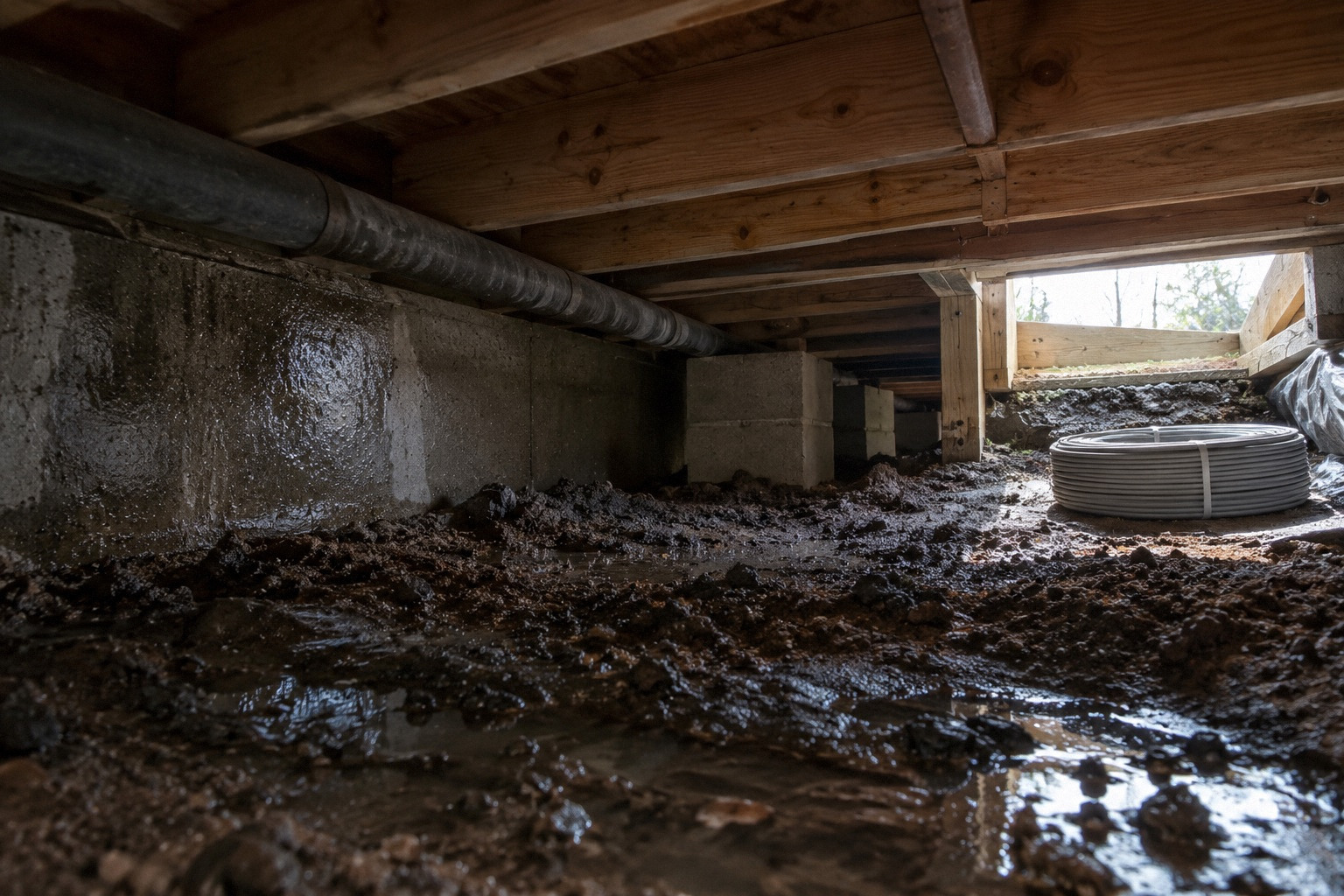
A crawlspace is rarely uniform. The area beside the access opening may be easy to see and reasonably dry while the far corner contains a plumbing leak, low clearance or evidence of seasonal water. A single photograph cannot represent the whole proposed path.
Mark the intended route against known features: water pipes, equipment, foundation openings, low areas and places used for maintenance access. The map should distinguish direct observations from assumptions. It is a planning aid for qualified assessment, not a reason for the owner to enter an unsafe or inaccessible space.
Moisture has several sources
The DOE's Crawlspace: Capillary Break at Crawlspace Floors describes how moisture can enter a crawlspace from the soil. In practice, an electrical routing discussion should also include known leaks, drainage history and any observed standing water without assuming one explanation covers every house.
A dry visit during favorable weather does not necessarily establish year-round conditions. Owners can contribute useful history: when water appeared, which repairs were made and whether conditions changed after landscaping or plumbing work. That history helps the professional decide what needs verification along the route.
Cable suitability follows the environment
Southwire's Romex Brand SIMpull Copper Type nonmetallic-sheathed cable (NM-B) Cable specification limits its NM-B application to dry locations. Whether a particular part of a crawlspace meets the relevant classification is an installation question, not something established simply by being beneath the house.
This is why “it is indoors” is not a complete material justification. The electrician should explain the environmental assumptions behind the selected cable. If the route includes a location with different conditions, the design may need a different method or a deliberate transition.
Conduit does not erase conductor requirements
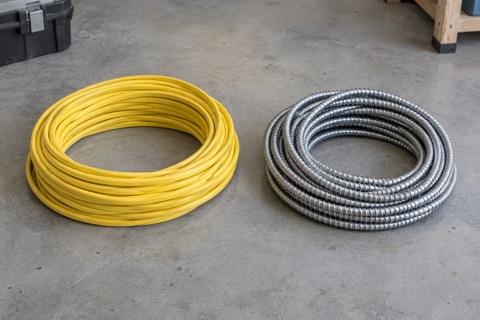
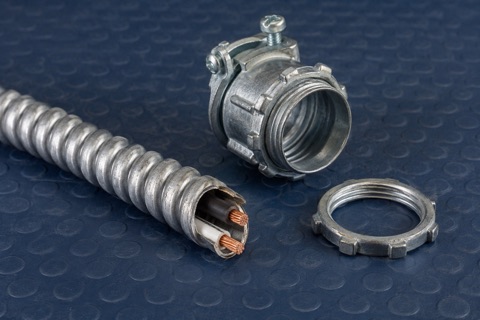
A protective-looking pathway can create the impression that anything inside it is isolated from its surroundings. The conductor or cable still has its own environmental limits, and the complete assembly must be appropriate.
Southwire's SIMpull THHN/THWN-2 Copper provides an example of conductors with stated wet and dry application ratings. That does not mean those conductors can be installed without a suitable wiring method. It demonstrates why both the pathway and its contents must be selected together instead of treating conduit as a universal cure.
Consider who uses the space later
A crawlspace may receive visits for plumbing, pest work, insulation, equipment repair or foundation maintenance. Wiring placed without regard to those activities can become an obstacle or be exposed to avoidable damage.
The route should be considered alongside access paths and service areas. This is a practical coordination question: how will another trade reach a valve or piece of equipment without disturbing the electrical work? A clear maintenance route can be more valuable than the shortest possible cable run.
A hypothetical dry-to-damp crossing
Imagine an outlet circuit routed beneath a living room. Most of the crawlspace is dry, but the proposed path crosses an area beside an exterior access opening where rainwater has entered in the past. The owner suggests using the same cable throughout because most of the run is protected by the house.
A better comparison asks whether the route can avoid that area, whether the moisture issue needs correction and what method is suitable if the crossing remains. The answer may differ from the method used elsewhere. The example shows why the most demanding segment cannot be ignored merely because it is short.
Encapsulation and insulation are future conditions
If crawlspace work is planned, share it before electrical routing is settled. New membranes, insulation, equipment or access arrangements can change what remains visible and how later service will occur.
The trades should agree on the intended final condition, not each design around a temporary snapshot. That does not mean an electrical article should prescribe a crawlspace moisture-control system. It means the wiring should not be installed on assumptions that another scheduled project will immediately invalidate.
Low clearance affects the practical options
A technically attractive route may be difficult to inspect or maintain if clearance is extremely limited. The owner should not assume that every area beneath the floor is usable simply because it exists on a drawing.
Discuss whether another path would reduce inaccessible connections or difficult transitions. A longer route through a serviceable area may offer advantages that are not apparent from cable length alone. The decision should balance actual access, building impact and electrical suitability.
Useful information for the electrician
Provide the history of water entry, known plumbing leaks, planned crawlspace improvements and the locations of equipment that needs future service. Identify any areas that have not been accessed recently.
Ask which parts of the proposed route were observed and how the selected materials match the final conditions. If the design is conditional on resolving a moisture issue, record that dependency explicitly. This prevents a preliminary route from being mistaken for a finished recommendation.
Local application and a practical conclusion
California includes many different crawlspace conditions; geography alone does not establish whether a route is dry, damp or wet. The adopted electrical requirements, local amendments and product instructions govern the particular installation.
A successful crawlspace rewire takes advantage of access without ignoring the environment. Its route remains understandable, its materials match the conditions and its placement accounts for future building maintenance. That is a more useful objective than selecting one cable type for every space beneath an old house.
Your project checklist
Questions that come up next
Is every crawlspace a wet location?
No blanket classification is appropriate. The actual conditions along the proposed route must be assessed.
Does conduit make NM-B suitable for any crawlspace?
No. Enclosing a cable does not remove its own application limits or the requirements for the complete wiring method.
Sources and further reading
- Crawlspace: Capillary Break at Crawlspace Floors
- Romex Brand SIMpull Copper Type NM-B Cable
- SIMpull THHN/THWN-2 Copper
Questions from homeowners
These discussions helped identify the problem. Reddit experiences are anecdotal; technical and legal statements rely on the sources above.