Identify the authority before searching for a rule
The mailing city is not always the permitting jurisdiction. A property may be inside city limits or in an unincorporated area administered by a county. Start with the official city or county property and building resources and confirm responsibility for the address. If staff redirects you, record the correct department and contact information. Avoid choosing the first permit page that appears in a general web search.
Ask whether another department also reviews the project, such as a historic-preservation office or a utility for service work. Those possibilities do not mean every rewire needs every approval. They mean the authority needs an accurate description before giving a useful answer. A permit decision based on a small repair description may not apply to the larger work eventually planned.
Describe the scope in ordinary, concrete terms
List what will be replaced, what will be added and what will remain. State whether the project concerns several rooms, the entire dwelling, a detached building or a service change. Explain whether walls or ceilings will be opened and whether the home remains occupied. If the technical boundary is not known yet, say that an assessment is pending rather than inventing a narrower description.
San José's electrical project page addresses rewiring and the need to keep work within the obtained authorization. Electrical Projects That is a city-specific source. San Mateo County's permit page describes its own application, review, inspection and revision stages. Apply for a Permit Their existence demonstrates why an owner should use the appropriate local process rather than a generalized nationwide permit checklist.
Ask questions that produce an actionable answer
The question do I need a permit is only the beginning. Ask which permit category covers the stated work, whether drawings or supporting information are required, who is eligible to apply and which inspection stages should be expected. Also ask how a change discovered during construction should be handled. These answers help the contractor price and schedule the work accurately.
If a written page appears to conflict with an oral answer, request clarification using the same scope description. Do not ask several departments with progressively different descriptions until one gives the answer you prefer. Keep a note of the date, staff role and guidance received, and obtain written confirmation where the issue materially affects the project. An informal conversation may help planning without being a formal approval.
Understand the distinction between repair and rewire
Owners and contractors may use the same word for different work. Repair might mean replacing a failed component, while a planned project replaces circuits across multiple rooms. Administrative exemptions, where they exist, have boundaries. Do not assume that calling extensive replacement maintenance makes it exempt. Conversely, do not assume that every minor electrical task has the same application requirements as a full renovation.
Portland's residential electrical permit guidance provides a separate local example with defined inspection stages and final closure. Residential Electrical Permits Use it to understand the kinds of questions to ask, not as the governing rule for a property elsewhere. The applicable authority must decide how its adopted requirements apply to the actual project.
Hypothetical inquiry to a permit office
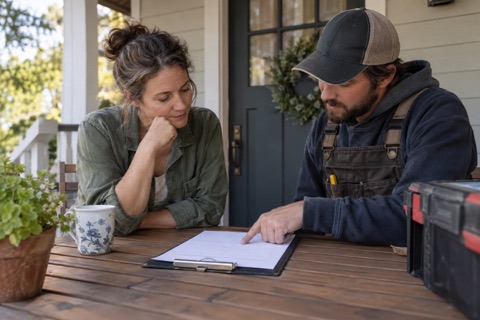
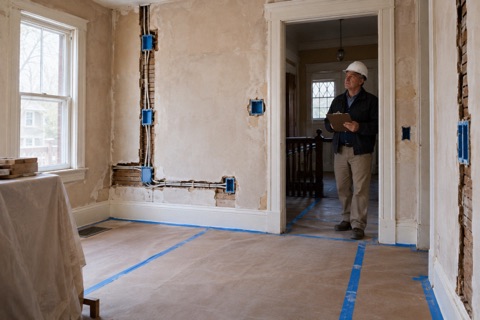
An owner could explain that a qualified electrical contractor is assessing older wiring in the upstairs bedrooms of a single-family house, that the planned work may replace several circuits and add devices, and that some wall openings may be needed. The owner should add whether panel or service work is proposed and ask what further information the office needs. This gives staff more to work with than asking whether old houses need rewiring permits.
Prepare the inquiry with:
- Property address and a confirmed city or unincorporated-county location.
- Building use, including whether it is a single dwelling, rental or multifamily property.
- Areas affected and the known electrical changes under consideration.
- Any proposed panel, service or detached-building work.
- Expected wall or ceiling disturbance and known historic designation, if any.
- Contractor information or a clear statement that contractor selection is still underway.
- Questions about application, inspections, scope changes and final records.
The example is not an application and does not authorize work. It is a way to obtain the correct application instructions before commitments are made.
Carry the answer into the contract and schedule
Once the requirements are clear, assign responsibility for the application, fees, inspection appointments and responses to corrections. Ask for the permit identifier once issued and verify that the description matches the agreed work. A statement that paperwork has been submitted is different from confirmation that a permit has been issued. Keep that distinction visible before the scheduled start.
During construction, return to the authority when the scope changes in a way that may affect approval. At completion, obtain the required final result and closure information. The benefit of checking early is practical: the contractor can sequence the work, the owner can plan access and neither party has to reconstruct the approval process after surfaces have been closed.
Your project checklist
Questions that come up next
Can I use the county page if my address is inside a city?
Confirm the actual building authority first. County guidance does not automatically govern incorporated cities.
Is submitted the same as issued?
No. An application may still be under review or awaiting information and fees. Verify the actual permit status before dependent work.
Sources and further reading
Questions from homeowners
These discussions helped identify the problem. Reddit experiences are anecdotal; technical and legal statements rely on the sources above.