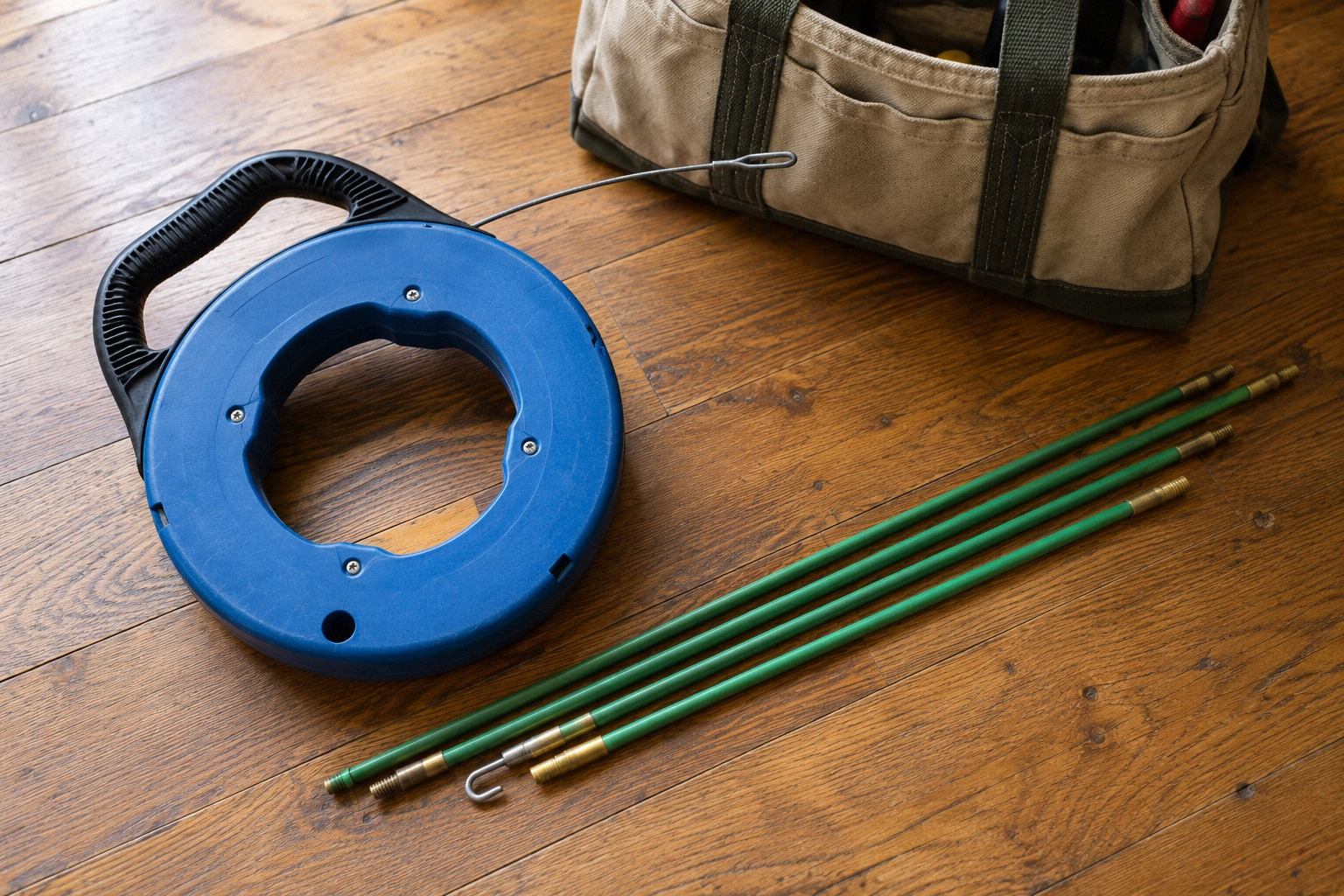
Tape and rods solve different mechanical problems
A fish tape is a flexible length stored in a reel. Fish rods are more directional sections used where their stiffness and reach are helpful. Neither description means the tool is appropriate for every cavity.
The practical comparison is about the path: is it continuous, does it change direction, and can the operator control the tool without damaging surrounding material? A route that looks short on a plan may be harder than a longer clear path because of one inaccessible transition.
Fiberglass does not make energized fishing acceptable
Klein's Klein 56380 fiberglass fish tape describes a 100-foot fiberglass tape with a spiral steel leader. The material combination alone shows why a simple label such as nonmetallic can mislead. More importantly, the manufacturer's warning prohibits use on or near live circuits.
The work arrangement must account for all relevant wiring in the space. An old room label is not proof that every conductor nearby is de-energized. Tool material should never be used to justify reaching into an electrically uncertain cavity.
Length is not the same as usable reach
A long tape can be useful, but its advertised length does not mean it can traverse that distance through an arbitrary wall. Resistance, turns and loss of directional control can limit what is practical.
Likewise, a rod's ability to span a void does not establish that the destination is clear or that the resulting cable route is acceptable. The route must still provide a suitable installed wiring method. Tools help execute a design; they do not determine the installation requirements by themselves.
Insulation changes the problem
A cavity containing insulation can behave differently from an empty chase. The tool may meet resistance or emerge in an unintended location. The owner should not assume that a wall is empty merely because the house predates modern insulation practices.
Before choosing a fishing strategy, establish what is known about later insulation work. If suspect hazardous material is present, the access plan requires appropriate assessment rather than exploratory disturbance. Mechanical convenience does not override material-hazard concerns.
A camera can answer a different question first
A borescope may reveal whether an obstruction is present at a critical transition. Klein's Klein ET500 video borescope illustrates a visual inspection tool with its own limitations and energized-circuit warning.
This can help avoid repeated blind attempts, but the image must be interpreted carefully. A camera view may show an obstruction without establishing its purpose or how it can be bypassed. The useful sequence is evidence about the path, then a suitable method, rather than escalating force when the first tool stops.
A hypothetical short but difficult route
Imagine an outlet only a few feet from an accessible service space. The owner assumes that a short fish will be easy. Between the two points, however, the cavity changes direction around framing and contains a later pipe.
A longer route through an adjacent plain wall may be more practical and less damaging. The example explains why distance alone is a poor measure of fishing difficulty. The number and character of transitions can matter more than the total length of cable.
Existing conductors are not an automatic pulling aid
An owner may suggest using an old conductor to pull in a new one. That idea requires professional evaluation of how the existing wire is routed and attached, what else it connects to and whether pulling would damage the building or other wiring.
Do not assume a visible loose end represents a continuous free path. Older installations may be secured or spliced in ways that are not visible from the endpoint. A failed attempt can break the conductor without establishing a useful new route.
Avoid the zero-hole sales promise
The historical The Rehab Guide, Volume 7: Electrical/Electronics discusses electrical rehabilitation methods, including the importance of available access. It is a useful reminder that the building controls the work, although its age makes it unsuitable as current code authority.
A tool demonstration in an empty modern wall cannot establish what will happen in a particular plaster house. A credible low-damage approach includes fallback access points. It should not depend on repeatedly forcing a tool through an unknown route to preserve a promise made before investigation.
Preserve both the cable and the finish
Successful fishing means more than seeing the new cable emerge. The cable must remain suitable for its intended installation, and the route must not have caused avoidable damage. Sharp edges, difficult turns and uncertain obstructions deserve consideration before the pull.
The homeowner can ask how the route will be assessed and what conditions would cause the method to change. There is no need to request a detailed pulling procedure. The useful information is whether the installer has a coherent plan and a defined alternative.
Tool choice follows the route
For California and other US homes, applicable electrical and building requirements still govern the final installation. A fish tape is not an exception to those rules, and a successful pull is not a substitute for a suitable wiring method.
The best tool is the one that addresses the established mechanical problem safely and with appropriate control. Sometimes that is a tape, sometimes a rod, sometimes a different route or a selective opening. Recognizing those limits is what makes a low-damage rewire realistic.
Your project checklist
Questions that come up next
Is fiberglass fish tape safe near energized wiring?
Klein's cited product warning says not to use any fish tape on or near live circuits. Fiberglass is not permission for energized fishing.
Can a long tape guarantee fewer wall openings?
No. Obstructions, transitions, insulation and installed-method requirements determine what is practical.
Sources and further reading
- Klein 56380 fiberglass fish tape
- Klein ET500 video borescope
- The Rehab Guide, Volume 7: Electrical/Electronics
Questions from homeowners
These discussions helped identify the problem. Reddit experiences are anecdotal; technical and legal statements rely on the sources above.