Shared neutral is a description, not a diagnosis
Two circuits can have a neutral relationship that is intentional and part of their original design. An older house can also contain a connection made during later alterations that joins circuits in an unintended way. Those situations should not be grouped together simply because both involve more than one circuit.
Ask what the electrician has actually established. Was the circuit traced and its arrangement confirmed, or was neutral sharing merely suggested as a possible explanation for a trip? The distinction affects what can reasonably be recommended next.
Why the protective device cares
Certain protective devices compare electrical quantities within the paths they monitor. A neutral carrying current associated with another circuit can therefore be incompatible with a device that expects a particular circuit arrangement. The exact issue depends on the product.
Schneider specifically addresses single-pole QO, QOB and HOM products with CAFI, AFI, GFI, DF or EPD suffixes. Its FAQ says their neutral must not be shared between two circuits. It identifies suitable two-pole alternatives with system limits: the cited two-pole CAFI is for 120/240 V, not 208Y/120 V. This is a concrete compatibility distinction, not a universal ban on protective breakers in old houses. See Can two single-pole protective breakers feed circuits sharing a neutral?.
Do not generalize one manufacturer's answer
An online explanation may be correct for a specific product and still be misleading when repeated as universal advice. Breaker family, protective functions, system voltage arrangement and panel compatibility can all affect the selection.
The homeowner should ask for the proposed model and the documentation supporting its use. “Use a two-pole breaker” is incomplete without those details. It does not establish that a particular panel accepts the device, that the system matches its rating or that the underlying circuit is correctly arranged.
Mapping comes before replacement shopping
An old breaker directory may label two circuits by room names even though the wiring crosses several spaces. A later remodel may have changed the endpoints while leaving the labels untouched. Mapping helps determine which outlets and loads belong to the circuits under investigation.
Klein's Klein ET450 circuit breaker finder and wire tracer documentation illustrates the availability of professional tracing tools. The existence of such a tool is not a reason for an owner to probe a live panel. It explains why a methodical tracing visit can provide information that a photograph of the breaker handles cannot.
A hypothetical paired-circuit problem
Imagine that a new protective breaker trips whenever a hall light is switched on, even though the breaker is labeled bedroom outlets. The owner is told the new breaker must be too sensitive.
That observation could have several explanations. A shared neutral is one possibility, but so are other wiring or equipment faults. A useful assessment records the exact trigger, traces the relevant relationships and interprets the product's diagnostics. Only then can a compatible arrangement be selected. Replacing the device with a less protective one would skip the question that caused the concern.
Separate compatibility from wiring condition
A suitable protective device cannot make a damaged conductor or loose connection sound. Conversely, a compatibility problem does not automatically prove that every cable in the circuit is beyond use. These conclusions need their own evidence.
The CPSC Guide to Home Wiring Hazards guide is a useful reminder that branch wiring condition matters independently of the selected protection. A diagnosis should therefore state both what caused the trip, where established, and whether additional defects were found. The owner can then understand which work addresses compatibility and which work addresses condition.
What circuit changes may accomplish
Where the existing arrangement is unsuitable or cannot support the planned work, redesigning part of the branch system may be appropriate. That can involve new circuits or a different distribution of loads. The specifics require a qualified design based on the actual house.
Avoid assuming that the only choices are no protection or a complete house rewire. There may be a bounded correction, but its limits must be demonstrated. Equally, avoid promising a small correction before the hidden relationships are understood.
Useful observations from the homeowner
A short event log can help without exposing anyone to wiring. Record which normal action preceded the trip, what lost power and whether a particular appliance was involved. Note whether the problem appeared after a recent change, but do not assume that timing proves causation.
If there are signs of overheating, burning odor or other urgent concerns, stop treating the event as a routine nuisance. Follow appropriate professional safety guidance. The log is for describing ordinary observations, not for repeatedly provoking a fault or trying different improvised connections.
Old-house language needs precision
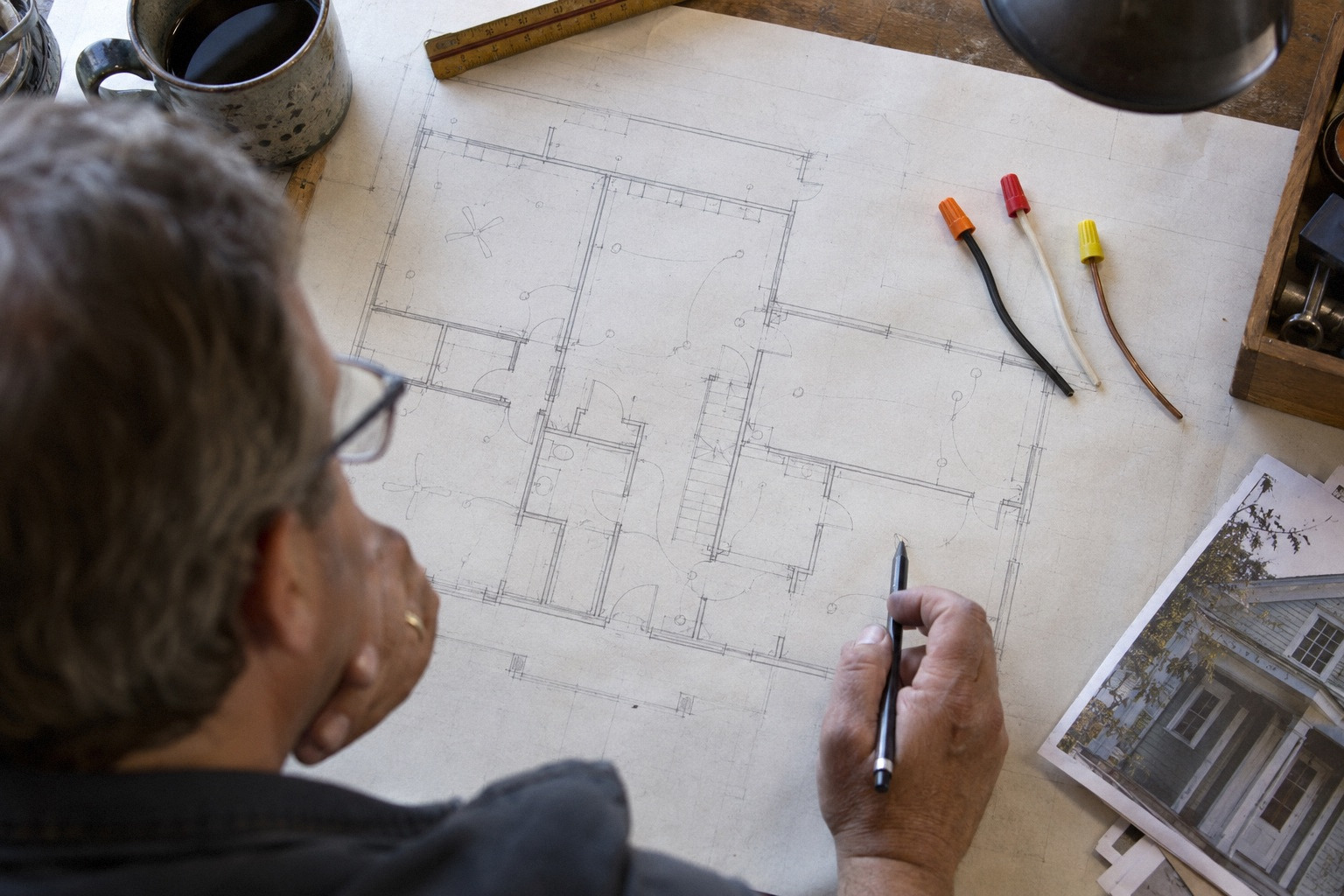
The phrase borrowed neutral is often used loosely in conversation. Ask the electrician to explain the actual arrangement rather than relying on a label whose meaning may vary between speakers. A simple diagram showing the circuits under discussion can be more useful than several paragraphs of jargon.
Similarly, ask whether the conclusion applies to the whole house or only the branches examined. Discovering one shared-neutral arrangement does not establish that every circuit uses the same pattern. This matters when planning a staged upgrade.
The decision should remain product-specific
California and other jurisdictions may have different adopted-code conditions for the proposed work. The design must fit those requirements and the selected equipment's instructions. A manufacturer FAQ is supporting evidence, not a substitute for verifying the installation.
The practical outcome should be a named compatible arrangement, a clear account of any circuit corrections and an explanation of remaining uncertainty. That is a stronger result than declaring all AFCIs troublesome or treating an unexplained trip as something to bypass.
Your project checklist
Questions that come up next
Does a shared neutral mean a circuit is automatically defective?
No. An intentional multiwire branch arrangement differs from unintended sharing. Its actual configuration and protective equipment must be assessed.
Will any two-pole AFCI solve the issue?
No. Panel compatibility, system rating, protective functions and the circuit arrangement must match the selected product.
Sources and further reading
- Can two single-pole protective breakers feed circuits sharing a neutral?
- Klein ET450 circuit breaker finder and wire tracer
- CPSC Guide to Home Wiring Hazards
Questions from homeowners
These discussions helped identify the problem. Reddit experiences are anecdotal; technical and legal statements rely on the sources above.