A neutral is not the same as a ground
The neutral is part of the circuit's normal operating arrangement. Equipment grounding has a different protective role. A ground conductor should not be treated as a substitute neutral merely because a smart device needs an additional connection.
Older switch locations may have been arranged to control a light without bringing a neutral to that box. That does not establish the condition of the wiring or tell you which modern product will work. The actual conductors and circuit arrangement need to be identified by a qualified person.
Smart controls need operating power
A conventional mechanical switch can simply open or close a path. A smart control needs power for its electronics as well as a way to control the lighting load.
Lutron's Why Do I Need a Neutral-Based Dimmer? explains why neutral-based and non-neutral dimmer designs differ. This is the technical reason that a smart device may require a connection the old switch did not. It is not a sign that every old house needs a complete rewire to gain any smart lighting.
No-neutral does not mean universal compatibility
A no-neutral dimmer must be suitable for the connected lamp or driver type and the intended operating arrangement. Some loads may respond poorly to a device that is not designed for them, including visible behavior at low light levels or when apparently off.
Use the exact model's documentation. Lutron's Caseta wireless controls specification distinguishes models, neutral requirements and load ratings. A product family name such as Caseta is not enough to determine compatibility because different controls within the family can have different requirements.
A dimmer is not always a switch substitute
The owner may want simple on/off control for a load that should not be dimmed. A no-neutral dimmer should not be selected merely because it avoids adding a conductor.
Identify the load and required function first. A lamp, fan motor and other equipment are not interchangeable control applications. The selected device must explicitly support the use. This is a reason to involve the electrician before buying a house-wide set of matching controls.
Multi-location control adds another distinction
A light controlled from more than one location may require a specific companion device, wireless arrangement or wiring configuration under the selected product instructions. Do not assume the new control can replace any one existing switch while leaving the rest unchanged.
Record how many control locations exist and what behavior the owner wants. The manufacturer may offer several supported arrangements, but those should be compared with the actual circuit. An online diagram for a different model or arrangement is not a reliable substitute.
The box can be the limiting factor
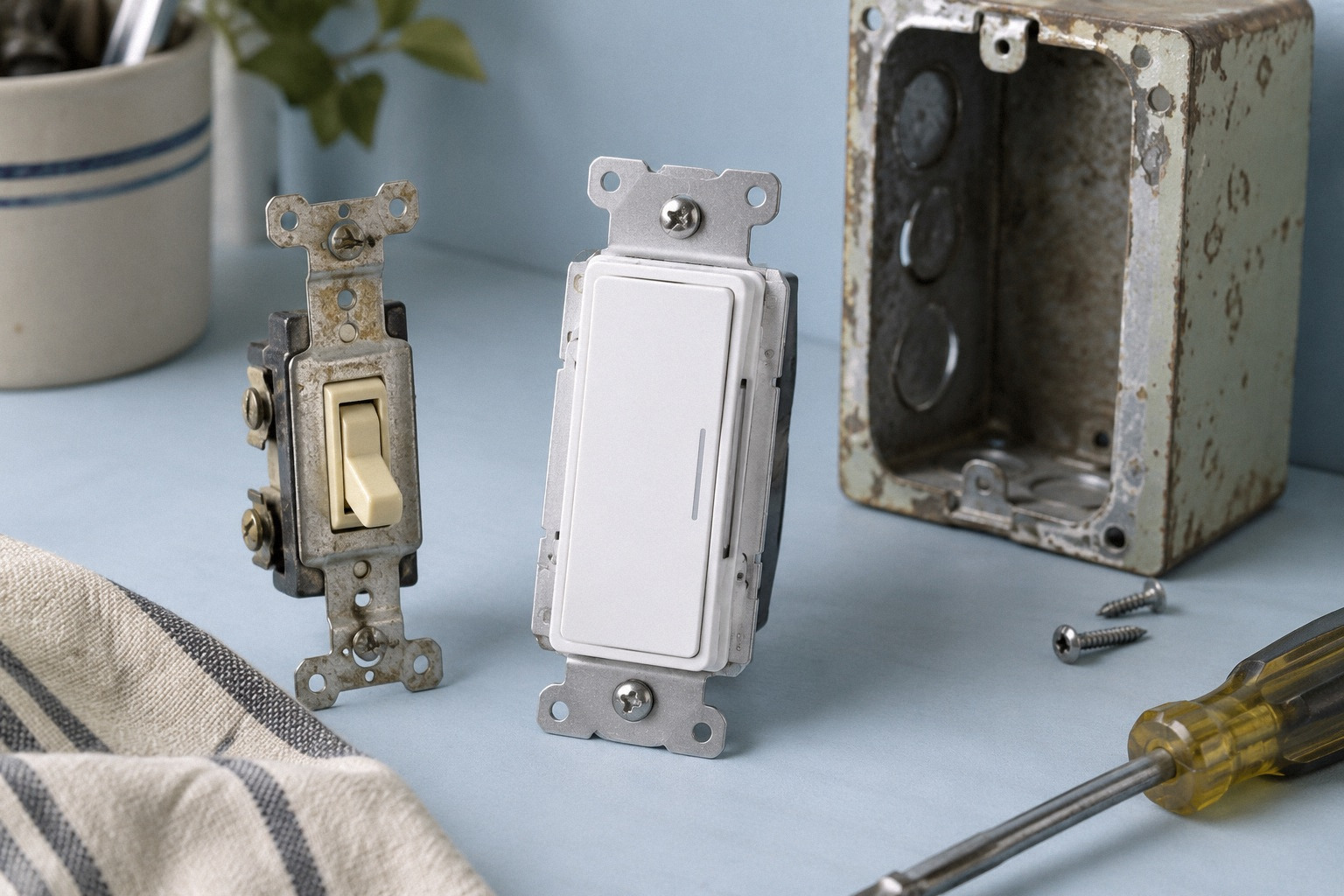
Smart controls can occupy more depth or space than an old mechanical switch. Existing conductor length and connection space also matter. A device may be electrically compatible yet physically unsuitable for the box.
Cantex's EZ08SF shallow 8 cubic inch old-work box provides an example of a shallow 8-cubic-inch enclosure. That stated volume illustrates why a shallow product cannot be assumed to fit every device assembly. Depth, usable capacity and the applicable box-fill requirements must all be considered.
A hypothetical bedroom upgrade
Imagine a bedroom with an old switch loop, compatible dimmable lamps and a shallow box. The owner wants remote lighting control without opening the plaster. A suitable no-neutral dimmer may address the missing-neutral issue, but the box still needs assessment.
If the device cannot be accommodated appropriately, the options might include a different supported product, a suitable box change or a broader wiring change. The example shows why solving one compatibility question does not automatically solve the whole installation.
A hypothetical utility-room mismatch
Now imagine a utility-room control serving equipment that is not a dimmable lighting load. The owner finds a popular no-neutral dimmer and assumes it will work because the wall switch looks ordinary.
The load type changes the answer. The appropriate solution must be a control specifically rated for that equipment and arrangement, or a circuit modification that supports a suitable device. Avoid forcing a lighting-dimmer solution onto a different application simply to preserve the existing conductor count.
When bringing a neutral is a sensible choice
If the wall is already open for a rewire, providing a suitable modern conductor arrangement at the control location may preserve more product options. The design should follow the applicable requirements and actual circuit.
This is different from claiming that every existing switch must immediately be rewired for smart control. The decision depends on access, the planned lighting system and the selected devices. A no-neutral product can be a practical bounded solution, while a planned rewire can justify a broader improvement.
Do not let automation hide a wiring problem
Brittle insulation, uncertain connections or an unsuitable grounding arrangement need their own assessment. Successful pairing with an app does not establish that the electrical installation is sound.
Likewise, a device that appears to operate initially may still be mismatched to the load or box. Evaluate the physical and electrical installation before judging success by software behavior alone.
Choose by model, load and location
For California and other jurisdictions, the applicable installation requirements and manufacturer instructions govern the work. The final selection should identify the exact control, compatible load, supported switching arrangement and suitable box.
That approach can deliver useful smart lighting without unnecessary wall disturbance while avoiding the opposite mistake: buying a convenient no-neutral device and expecting it to solve every limitation of an old electrical system.
Your project checklist
Questions that come up next
Can equipment ground be used as a neutral?
No. They serve different functions; do not substitute one for the other to power a smart control.
Does every product in a smart-control family have the same neutral requirement?
No. Requirements differ by model and load type. Check the exact device documentation.
Does successful app pairing prove the installation is suitable?
No. Wiring condition, load compatibility and box suitability remain separate requirements.
Sources and further reading
- Why Do I Need a Neutral-Based Dimmer?
- Caseta wireless controls specification
- EZ08SF shallow 8 cubic inch old-work box
Questions from homeowners
These discussions helped identify the problem. Reddit experiences are anecdotal; technical and legal statements rely on the sources above.