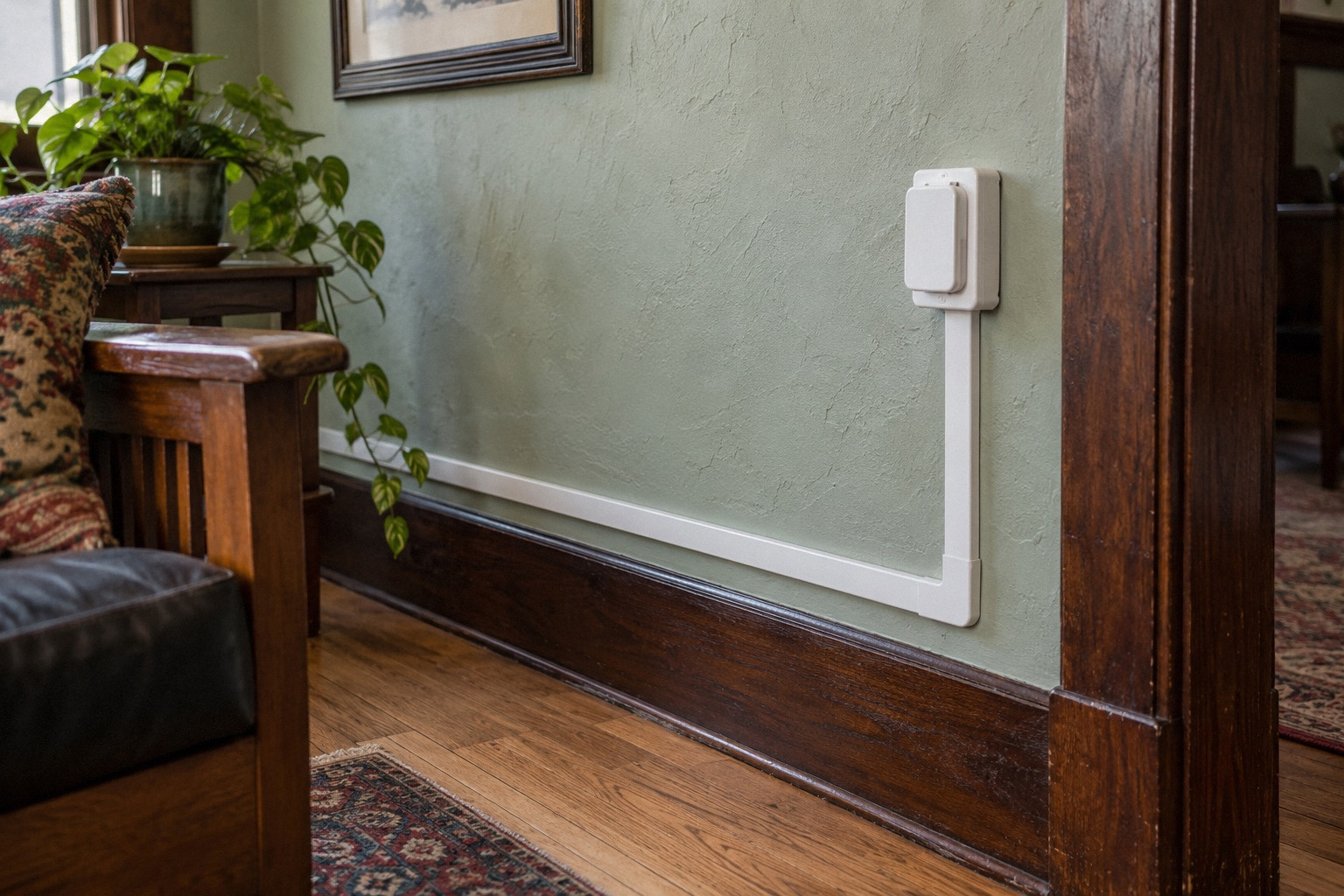
Understand the product before judging its appearance
Legrand's 700WH specification gives a concrete example: an indoor, single-channel steel surface raceway intended for dry locations. Its listed cross-section is approximately 0.63 inch deep by 0.75 inch high, and the document identifies UL 5 surface-metal-raceway compliance. Those details apply to that product, not every strip sold as a cable cover. See Wiremold 500/700 Series Small Raceway.
The dimensions help an owner visualize a straight run, but they do not determine conductor capacity by themselves. Fittings and boxes can project farther. A useful mockup therefore includes an outlet box and a corner, not merely a narrow sample held against the baseboard.
Draw the whole route
Start with the source location and every intended endpoint. Mark inside corners, outside corners, door trim and places where the route changes height. A straight wall may be simple while a doorway creates a conspicuous detour.
Consider furniture as well as architecture. An outlet hidden behind a large cabinet may be inconvenient, while a raceway placed where chairs strike the wall may face unnecessary wear. The desired route should be reviewed against normal room use before it becomes an installation decision.
Compare three different approaches
A fully concealed route can preserve the visual appearance but require access openings. A fully surface-mounted route can reduce some finish disturbance but remain visible throughout. A hybrid route can use concealed wiring where access is practical and surface raceway across the difficult segment.
The hybrid approach is often overlooked because discussions become a vote for or against visible wiring. The useful comparison is functional: which segments are easy to conceal, which are costly in building fabric and where a deliberate transition can occur without creating an awkward assembly.
Conductors and raceway must be selected together
A raceway listing does not make every cable or conductor suitable inside it. Conductor type, quantity, dimensions and circuit arrangement remain part of the design. Southwire's SIMpull THHN/THWN-2 Copper specification is an example of conductor documentation, not a universal recipe for filling a surface system.
This matters when someone wants to use leftover cable simply because it fits through the opening. Physical fit is only one concern. The complete assembly must follow the selected system's instructions and the applicable electrical requirements.
Power and communications are separate design questions
Some raceway products are marketed for either power or communications applications. That does not automatically authorize mixing power conductors and data cables in a single undivided channel. The selected system and applicable separation requirements must support the intended arrangement.
Before buying parts, specify whether the route serves receptacles, a lighting circuit, network cable or several functions. If multiple systems are desired, a different raceway family or separate paths may be needed. A small single-channel product should not be treated as an unlimited utility corridor.
A hypothetical plaster study
Imagine a study with original plaster on three walls and a renovated closet on the fourth. The owner needs two additional receptacle locations near the desk. Concealed access is straightforward in the closet but difficult along the exterior masonry wall.
A hybrid concept could bring a new route to a suitable transition near the closet, then use listed surface raceway along the difficult wall. Another concept might use selective plaster openings. Comparing those options requires showing the boxes, turns and furniture relationship. The visual result cannot be judged from the word Wiremold alone.
Grounding and transitions belong in the design
Metal components need an appropriate grounding and bonding arrangement for the selected installation. Do not assume that touching two metal parts creates the required path or that paint, fittings and attachment details are irrelevant.
The transition from an existing box to surface raceway is also a designed connection, not a loose wire emerging from a wall. Ask the electrician to identify the compatible transition components. This is where a collection of plausible-looking parts must become a listed, coherent installation.
Historic interiors need a visual hierarchy
The NPS Preservation Brief 18: Rehabilitating Interiors recommends evaluating significant interior spaces and features before alterations. Applied here, that means considering whether the route crosses a prominent decorative element or can follow a less sensitive part of the room.
A surface route can be less damaging than extensive concealed work, but it can also be visually intrusive if placed carelessly. Neither outcome is automatic. Review the actual line, finish and endpoints against the features that make the room important.
Future access and changes
A surface system can make some future alterations easier, but it should not be described as infinitely expandable. Raceway capacity, available circuit capacity and product compatibility still limit changes.
Record the product family and route so a later electrician can identify what was installed. If the room may become an office or receive different equipment, discuss those foreseeable uses now. That supports a suitable initial design without pretending to reserve unlimited electrical capacity.
Make the decision concrete
For California and other US projects, the locally adopted electrical requirements apply alongside the manufacturer's instructions. The owner can make the aesthetic decision after the electrician establishes technically suitable options.
The final comparison should show visible dimensions, outlet locations, route transitions and the finish disturbance associated with each alternative. Surface raceway becomes a credible preservation tool when it is evaluated as an actual room installation rather than accepted or rejected as an abstract style.
Your project checklist
Questions that come up next
Is Wiremold the same as a cord cover?
No. A listed surface raceway is a wiring system with compatible components. A decorative cord cover may have a different purpose and rating.
Can power and Ethernet share any raceway?
No. The selected system and applicable separation requirements must support the arrangement; a single channel is not automatic permission to mix them.
Sources and further reading
- Wiremold 500/700 Series Small Raceway
- SIMpull THHN/THWN-2 Copper
- Preservation Brief 18: Rehabilitating Interiors
Questions from homeowners
These discussions helped identify the problem. Reddit experiences are anecdotal; technical and legal statements rely on the sources above.