Why this material changes the default assumption
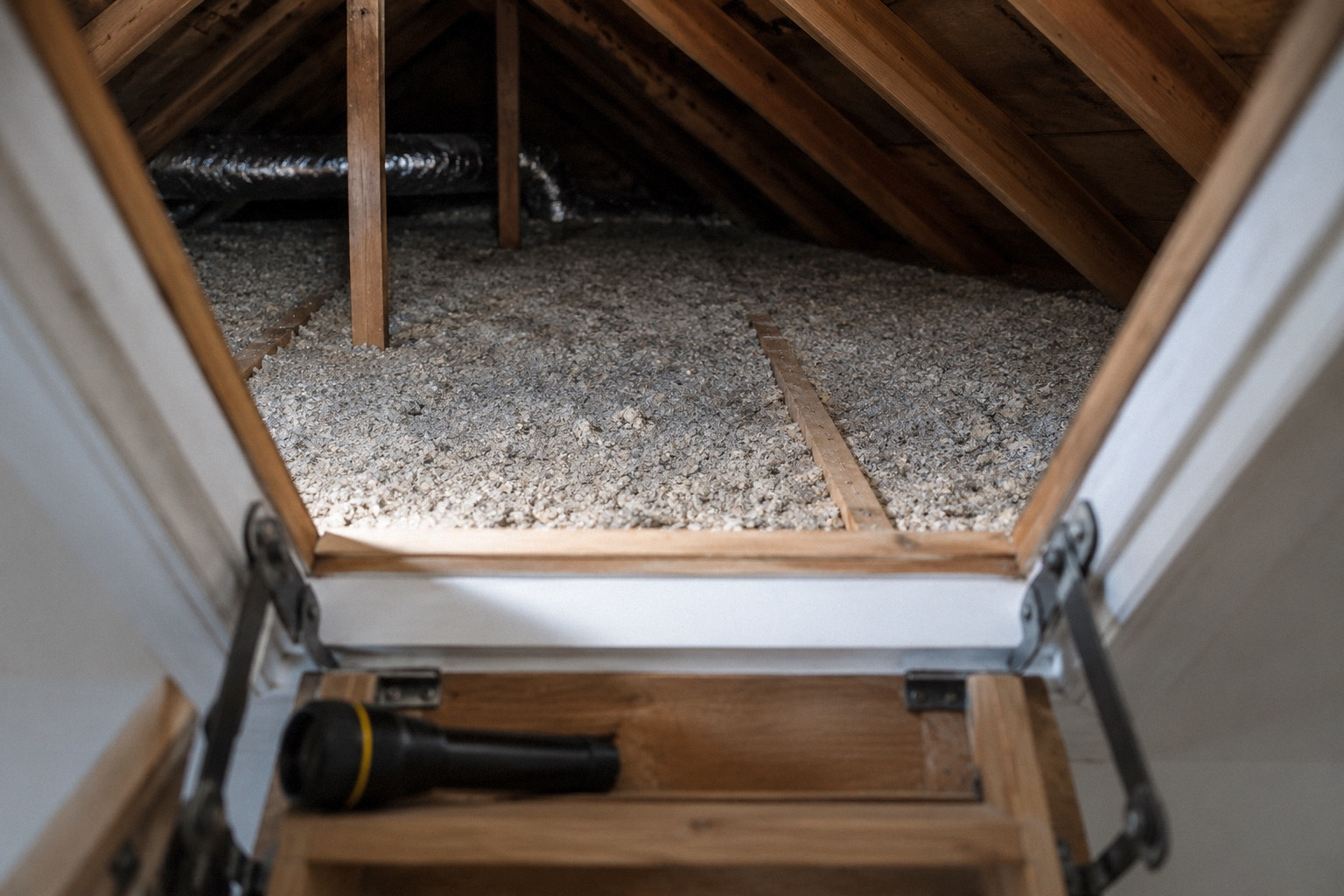
Many low-damage rewire plans rely on reaching rooms from above. That approach assumes the attic can be entered and worked in without creating another hazard. Loose vermiculite changes that assumption.
EPA's My attic has vermiculite insulation. Am I at risk? advises assuming the material may be contaminated with asbestos and leaving it undisturbed. The practical consequence is that ordinary route exploration should not begin by shifting the loose fill aside. The access problem must be reconsidered before the electrical investigation proceeds through the affected area.
Do not turn a route survey into material disturbance
Owners may want to clear a small working path or uncover a junction so the electrician can inspect it. Those actions can disturb the very material that requires caution.
The route survey should initially use information available without disturbing the insulation: existing records, safe observations from permitted access and the locations of rooms below. The professional team can then determine whether more information is needed and how it should be obtained appropriately.
A negative-looking sample is not a casual clearance
Vermiculite is not a suitable subject for improvised homeowner sampling. EPA's broader Asbestos Frequently Asked Questions recommends qualified professional involvement where suspect material will be disturbed.
The interpretation of any testing also needs to fit the material and the proposed work. Do not treat one casually collected sample or an online photograph as permission to move the attic insulation. The person assessing the situation should explain what the evidence can and cannot establish.
Separate three questions
The first question is how the insulation should be treated. The second is what wiring is present and whether it remains connected. The third is how the new circuits can reach their endpoints.
These questions overlap, but none automatically answers the others. A material assessment does not establish electrical condition. A new panel does not prove the old attic conductors are abandoned. And a plan to replace wiring does not authorize uncontrolled disturbance of insulation along the route.
A hypothetical upstairs rewire
Imagine an upstairs bedroom with an old ceiling-light circuit. The attic above contains loose vermiculite, while a nearby closet offers a possible alternate approach. The owner assumes attic access will produce the fewest holes.
The comparison should include the material-related constraints, not merely the visible finish impact. A carefully selected opening in a plain closet wall may be preferable to disturbing the attic. If the alternate route proves impractical, specialist planning may be needed for the affected attic area. The example illustrates the tradeoff without prescribing a remediation method.
Alternative routes deserve a real review
Possible alternatives can include secondary spaces, localized access from the room side or an appropriate surface method. Their feasibility depends on the building and the electrical endpoints.
Do not dismiss an alternative because it creates a small finish repair. The relevant comparison includes the consequences of material disturbance and the confidence in the route. A promise of no wall damage can become a poor objective if it pushes the work into an inadequately assessed attic.
Other planned attic work belongs in the conversation
Insulation upgrades, roof work, ventilation changes, storage platforms and mechanical equipment can all affect future attic access. If these projects are already planned, share them with the specialists.
Coordinating known future work may prevent separate visits from repeatedly confronting the same material issue. It does not mean every future improvement should be undertaken immediately. It means the access decision should reflect the house's actual plans rather than only the first electrical task on the calendar.
California context
The Asbestos in the Home and Workplace resource provides California home and workplace information and links a state factsheet. It is useful context for owners whose rewire also involves suspect attic material.
The applicable requirements can extend beyond general federal consumer guidance. The responsible professionals should determine the California and local obligations for the work. Do not assume that a rule summarized for a homeowner in another state describes the qualifications or procedures needed for the California project.
What to tell the electrical contractor
Disclose the vermiculite before a site visit intended to include attic access. Describe where it was observed and provide any existing professional reports. Explain which rooms need new wiring and whether alternate service spaces are available.
This allows the contractor to plan the assessment appropriately rather than discovering the material after entering the attic. It also makes the initial route recommendation more realistic. A contractor who has not considered the insulation cannot reliably promise an attic-based low-damage rewire.
What a coordinated plan should establish
The plan should state which areas remain undisturbed, which routes are preferred, what information is still needed and whether specialist material work precedes electrical access. If only part of the attic is addressed, the limits should be clear.
The owner should not have to infer that an assessment of one area clears the whole attic. Keep the material findings and the electrical route drawing together so later trades understand the same boundaries.
The practical priority
The goal is to obtain a suitable new electrical system without creating unnecessary exposure while gaining access. That may require a different route or a different sequence than a house with an unobstructed attic.
Respecting EPA's vermiculite guidance does not mean assuming the entire rewire is impossible. It means treating attic access as a decision that needs evidence and coordination. Once that decision is made properly, the electrical work can proceed on a realistic basis.
Your project checklist
Questions that come up next
Can I vacuum a narrow path through vermiculite for the electrician?
Do not disturb it to create access. EPA advises treating vermiculite as potentially asbestos-contaminated and leaving it undisturbed pending appropriate guidance.
Does replacing the old wiring resolve the vermiculite issue?
No. Wiring condition, material assessment and access planning are separate questions that must be coordinated.
Sources and further reading
- My attic has vermiculite insulation. Am I at risk?
- Asbestos Frequently Asked Questions
- Asbestos in the Home and Workplace
Questions from homeowners
These discussions helped identify the problem. Reddit experiences are anecdotal; technical and legal statements rely on the sources above.